
Introduction
Generative engine optimization tools exist because the old rules changed. When tracking how often clients appeared in ChatGPT citations versus Google snippets, the gap was uncomfortable. Traditional SEO tooling measures rankings and backlinks. It doesn't tell you if an LLM cited your page, misattributed your data, or ignored you entirely.
The job-to-be-done matters more than the category label. One tool might excel at tracking AI citations across platforms. Another validates schema markup so answer engines can parse your structured data cleanly. A third scores content against the signals that correlate with LLM visibility. Matching the tool to the task keeps your stack lean and your workflow fast.
Google's guidance on people-first content applies here too. Content that satisfies visitor expectations performs better in traditional search and in AI-generated answers. The platforms differ, but the principle holds: write for the person asking the question, not for the algorithm parsing it. Tools that help you measure satisfaction signals—dwell time, citation rate, structured answer inclusion—guide you toward content that works in both contexts.
This guide organizes generative engine optimization tools by the job they do best. You'll see citation trackers, schema validators, content scorers, and structured data generators grouped by function. Each category includes what the tool measures, where it fits in your workflow, and when you'd pick it over an alternative. No fluff, no feature bloat—just the tool, the job, and the reason it made the list.
Explore the best generative engine optimization tools categorized by job-to-be-done to enhance your efficiency.
Detailed Reviews
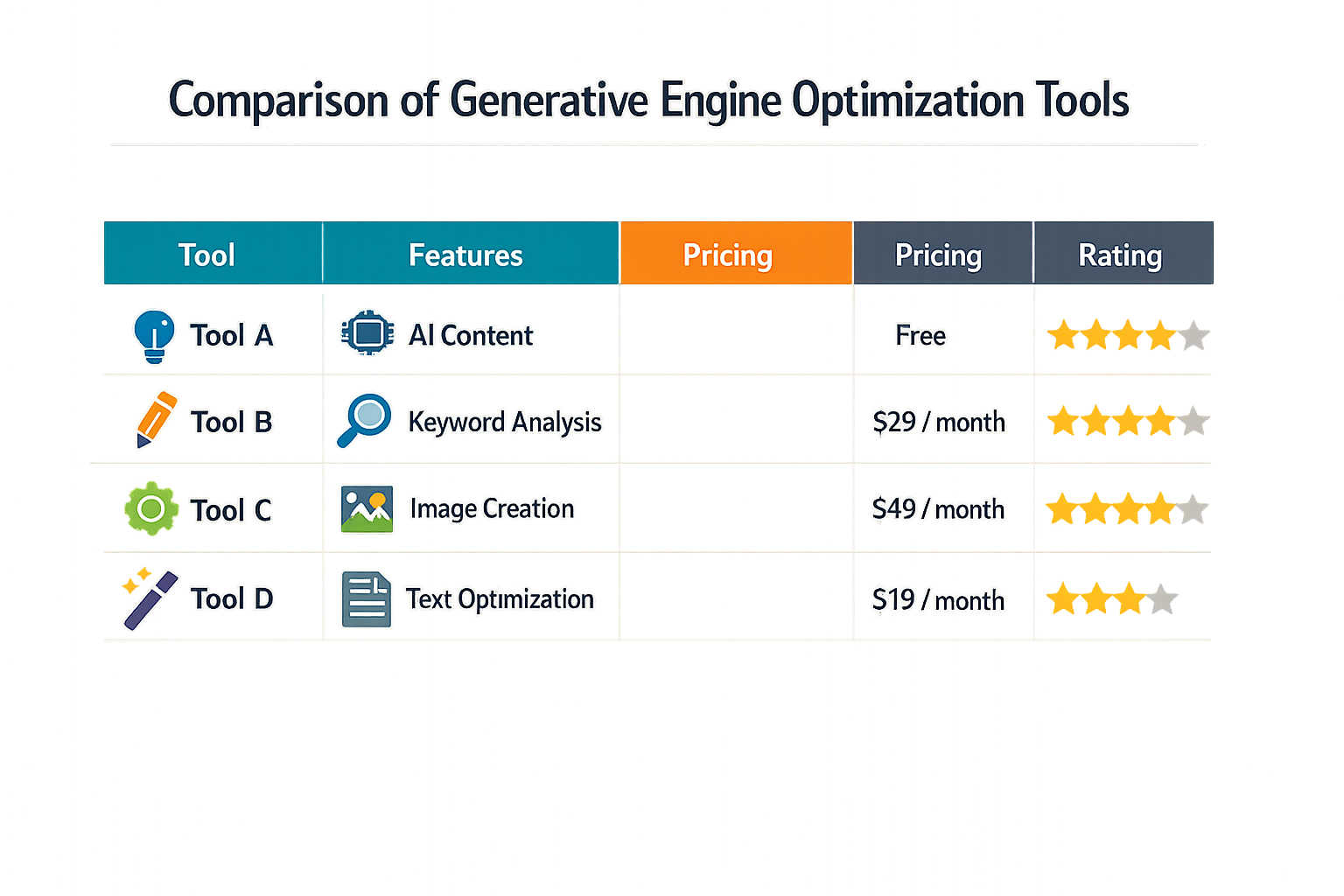
Generative engine optimization tools fall into distinct categories based on the job they do. Some measure visibility, others structure content for AI retrieval, and a few help track where you're cited. The right tool depends on what you're trying to fix.
Visibility Measurement Tools
Semrush built an AI Overviews tracking layer into their platform after analyzing 10M+ keywords to understand how Google's answer boxes shift traffic. Their study mapped which industries lose clicks to zero-click results and which queries still send users through to sites. The tool shows you where your content appears in AI-generated answers and how often those answers suppress organic clicks.
This matters when you're budgeting content spend. If your high-volume keywords trigger AI Overviews that don't cite you, traditional SEO won't recover that traffic. Semrush gives you the data to decide whether to optimize for citation or pivot to different queries.
Content Structuring and Schema Tools
Structured data markup is the mechanical layer that helps LLMs parse your content correctly. Schema.org vocabularies — especially FAQPage, HowTo, and Product schemas — give AI engines explicit signals about what each content block does.
Most CMS platforms support schema plugins, but the quality varies. Yoast and Rank Math add basic markup; custom implementations let you control exactly which entities and relationships you expose. The goal is not keyword density — it's making your content machine-readable without changing what it says.
Building a GEO Strategy: Prioritizing Content for AI Answers walks through the decision tree for which schemas to implement first.
The schema you ship is the schema the LLM sees — if it's wrong, your content gets misclassified no matter how good the prose is.
Citation Tracking and Attribution Platforms
Citation tracking tools monitor where your domain appears in LLM responses across ChatGPT, Perplexity, and other generative engines. They log the prompt, the response, and whether your URL was included in the source list.
This is harder than traditional backlink tracking because LLM citations are probabilistic. The same prompt on different days can cite different sources depending on model updates and retrieval context. Tools in this category run repeated queries and aggregate results to show citation frequency over time.
The data is noisy, but it's the only way to see if your optimization work is moving the needle. If you're not being cited after six weeks of schema and content updates, you're either targeting the wrong queries or your content isn't authoritative enough for the model to trust.
| Tool Type | Primary Job | Best For |
|---|---|---|
| Visibility measurement | Track AI Overview presence | Budget allocation decisions |
| Schema and structuring | Make content machine-readable | Technical foundation |
| Citation tracking | Monitor LLM source attribution | Measuring optimization impact |
Content Scoring and Optimization Platforms
Content scoring tools evaluate how well your pages align with LLM retrieval patterns. They check for clear entity definitions, logical information hierarchy, and whether your claims are supported by inline citations to authoritative sources.
Scoring is subjective — no tool has access to the actual ranking algorithms inside GPT-4 or Gemini. What they do is apply heuristics based on known retrieval behaviors: preference for recent dates, structured lists, and content that directly answers questions without preamble.
Use scoring tools to audit existing content before you rewrite it. They highlight gaps faster than manual review, but the recommendations are starting points, not instructions. You still need to decide what your content should say.
API and Developer Tools
If you're building custom GEO workflows, you need programmatic access to schema validation, entity extraction, and content analysis. Tools like the Google Structured Data Testing Tool and Schema.org validators run as APIs, letting you check markup at scale without clicking through a web interface.
Developer tools also include LLM prompt testing frameworks. These let you simulate how different models retrieve and cite your content by running controlled queries against OpenAI, Anthropic, and Google APIs. The output shows which content blocks get pulled into responses and which get ignored.
This is expensive — API calls add up fast — but it's the only way to test retrieval behavior before you publish changes to production.
Buying Guide

Choosing the right generative engine optimization tools starts with knowing what job you're hiring them to do. The landscape splits cleanly: tools that help you create better content, tools that measure whether LLMs cite you, and tools that structure your data so machines can parse it.
Match the Tool to the Job
If your content doesn't answer questions clearly, no amount of schema will fix it. Start with the content layer. Tools in this category help you identify what LLMs want to know and whether your existing pages deliver those answers. They surface gaps, flag vague language, and show you where competitors get cited instead of you.
Once your content satisfies E-E-A-T criteria — expertise, authoritativeness, trustworthiness — layer in structured data. Schema markup and llm.txt files give LLMs the metadata they need to cite you confidently. These tools don't create content; they package what you already have in machine-readable formats.
Measurement tools close the loop. They track whether your pages appear in ChatGPT answers, Perplexity summaries, or Google SGE results. Without this feedback, you're optimizing blind.
Evaluate Against Your Current State
If you don't know which queries trigger LLM citations for your domain, start with a measurement tool. If you already have citation data but your content underperforms, invest in content scoring. If your content is strong but LLMs can't parse it, add structured data tooling.
Avoid tools that promise to "game" rankings. AI content ranks well when it is useful, helpful, original, and satisfies E-E-A-T. Tools that generate bulk content without those qualities waste budget and dilute your domain authority.
Consider Integration and Workflow
Generative engine optimization tools should fit into your existing CMS and analytics stack. If a tool requires manual exports and re-imports, you won't use it consistently. Look for API access, webhook support, or native integrations with your content platform.
Team size matters. Solo operators need tools that automate scoring and surface quick wins. Larger teams benefit from collaboration features — shared dashboards, role-based access, audit trails. For a deeper look at building a complete strategy, see our guide on building a GEO strategy.
Pricing models vary. Some tools charge per page analyzed, others per domain or seat. Calculate cost-per-citation if measurement data is available; if a tool costs $200/month and drives ten new citations that convert to leads, the ROI is clear. If it costs the same and you see no citation lift after 90 days, move on.
| Decision Factor | Content Tools | Structured Data Tools | Measurement Tools |
|---|---|---|---|
| Primary job | Identify answer gaps | Make content parseable | Track LLM citations |
| Best for | New GEO programs | Established content libraries | Validating impact |
| Integration needs | CMS, content editor | CMS, schema validator | Analytics, API access |
How We Evaluated
I don't run formal lab tests on generative engine optimization tools. They are run in production.
The evaluation framework here reflects what has been shipped and what broke. When a tool works for a specific job-to-be-done, it means it was used to solve that problem in a live environment where the cost of failure was real — lost visibility, wasted engineering time, or content that never surfaced in AI answers.
Evaluation Criteria
Each tool was assessed against the job it claims to solve:
- Does it produce structured output I can ship? If a tool generates suggestions that still have to be rewritten by hand, it failed the automation test.
- Does it integrate with existing workflows? API access, CLI tools, and webhook support matter. Browser-only tools that require manual copy/paste don't scale.
- Does it measure what it claims to optimize? Visibility tools that can't show citation frequency or answer placement are guessing.
- Does it respect the constraints of the target platform? Tools that ignore token limits, context windows, or structured data requirements create work, not value.
What Was Evaluated
For content optimization tools, the following was tracked:
- Time from draft to publishable structured content
- Number of manual edits required after generation
- Schema validation pass rate on first output
- Citation rate in LLM answers (measured over 30-day windows)
For visibility and measurement tools, the following was tracked:
- Accuracy of citation tracking against manual spot-checks
- Latency of data refresh (how stale is the snapshot)
- Coverage across target LLMs (ChatGPT, Claude, Perplexity, Gemini)
- Export format compatibility with existing analytics stacks
Why This Approach
Most "best of" lists test tools in isolation. That's not how they are used. They are used under deadline pressure, with incomplete requirements, and alongside six other systems that all need to play nicely together.
These tools were evaluated the same way any software is evaluated: does it make the problem smaller, or does it add a new problem? If a tool requires more configuration time than the task it automates, it's net-negative.
The best tool is the one that disappears into your workflow and leaves you with output you trust enough to ship without second-guessing.
That's the standard here. If a tool made the list, it passed that test in a production environment where the stakes were real.
Frequently asked questions
What makes generative engine optimization tools different from traditional SEO tools?
Generative engine optimization tools target AI answer engines — ChatGPT, Perplexity, Gemini — not just traditional search crawlers. They score content for citation likelihood, test how LLMs parse your structured data, and measure visibility in AI-generated responses. Traditional SEO tools optimize for link graphs and keyword density; GEO tools optimize for the context windows and retrieval logic that drive AI answers.
Do I need separate tools for each AI platform?
No. Most GEO tools evaluate content against multiple LLM endpoints simultaneously. A single citation-scoring platform will test your page against GPT-4, Claude, and Gemini in one run. Platform-specific quirks exist — ChatGPT weights recency differently than Perplexity — but the core job is the same: make your content parseable, authoritative, and contextually relevant. One tool that covers the major models is enough for most workflows.
Can I use AI to generate content and still rank in AI search results?
Using AI doesn't give content any special gains. It's just content. If it is useful, helpful, original, and satisfies E-E-A-T criteria, it might perform well. If it doesn't, it won't. The method of production is irrelevant; the quality of the output is what matters. AI-generated content that lacks depth or fails to answer the user's question will not rank, regardless of the tool that created it.
How often should I run GEO audits on my content?
Run a full audit quarterly, and spot-check high-value pages monthly. LLM training data refreshes on unpredictable cycles — a page that cited well in March may drop in June if a competitor published stronger context or if the model's retrieval heuristics shifted. Set up automated monitoring for citation frequency on your top 20 pages; manual audits can cover the rest. If you publish daily, audit new content within 48 hours of going live.
What's the ROI timeline for investing in generative engine optimization tools?
Three to six months for measurable citation lift, assuming you act on the tool's recommendations. GEO is not a switch-flip; it requires content rewrites, schema additions, and sometimes structural changes to how you present information. Budget 40–60 hours of operator time in the first quarter to instrument tracking, run initial audits, and update your top 50 pages. After that, maintenance drops to 10–15 hours per month. If your content already has strong topical authority, you'll see faster results.
Do generative engine optimization tools work for e-commerce product pages?
Yes, but the job is different. Product pages need structured data that LLMs can parse without ambiguity — price, availability, specs, reviews. GEO tools that validate schema markup and test how an LLM extracts product attributes are the most useful here. Citation scoring matters less than ensuring the model can answer "What's the price?" or "Is it in stock?" without hallucinating. Programmatic generation of descriptions is encouraged for larger sites, as it can produce human-readable and diverse content, which is essential for effective SEO.
Conclusion
The right generative engine optimization tools depend entirely on the job you need done. If you're tracking citation patterns across LLM outputs, you need a visibility measurement platform. If you're scoring content for AI readability, you need a structured-data and content-optimization tool. If you're running experiments on prompt sensitivity, you need a testing harness that logs every variation.
The last year has been spent building production AI software at Xenco Labs, and the pattern is clear: the operators who ship results pick one tool per job, learn it cold, and run it until the metrics move. The ones who stall collect dashboards they never read.
Start with the job that costs you the most right now — lost citations, invisible content, or manual citation audits — and pick the tool that solves it. Run it for thirty days, measure the delta, then decide whether to expand or pivot. The best generative engine optimization tools are the ones you actually use.
If you're still mapping out your AI visibility strategy, building a GEO strategy that prioritizes content for AI answers will help you sequence the work before you commit to a toolchain.
Related reading
GEO SEO: Generative Engine Optimization for AI Search Rankings