
Introduction
AI search engines changed the rules. By May 2025, nearly 69% of all searches ended without a single click to any website, up from 65% in 2020. When AI Overviews are involved, the figure climbs to nearly 80%. Users got their answers without visiting your site.
This shift demands a different approach. AI search optimization is the practice of making your content retrievable, extractable, and citation-worthy in AI-powered answer systems. It's not about gaming algorithms — it's about building content that AI engines trust enough to cite.
Ranking in AI search results requires understanding both generative and answer engine optimization. At ScoreCraft, I built a system that scores content for SEO and AI visibility, going beyond traditional tools. The platform-agnostic approach focuses on structured data and authoritative content because that's what AI search engines prioritize.
Why Traditional SEO Falls Short
Keyword stuffing and backlink farming don't move the needle in AI search. These engines parse semantic meaning, evaluate source credibility, and extract facts from structured markup. If your content lacks clear schema, verifiable sources, or logical information architecture, it won't surface in AI-generated answers.
The gap between ranking in traditional search and ranking in AI is measurable. Sites optimized only for Google's classic algorithm see traffic drops when AI Overviews dominate their target queries. Sites built with structured data, clear authorship, and research-grounded claims maintain or grow visibility.
This guide walks through the strategies that work: understanding how AI engines parse content, optimizing for extractability, implementing structured data correctly, and measuring what actually moves your AI visibility metrics. No theory — just the steps that produce results.
Learn how to rank in AI search results with actionable steps and strategies for improving your visibility.
Understanding AI Search Engines
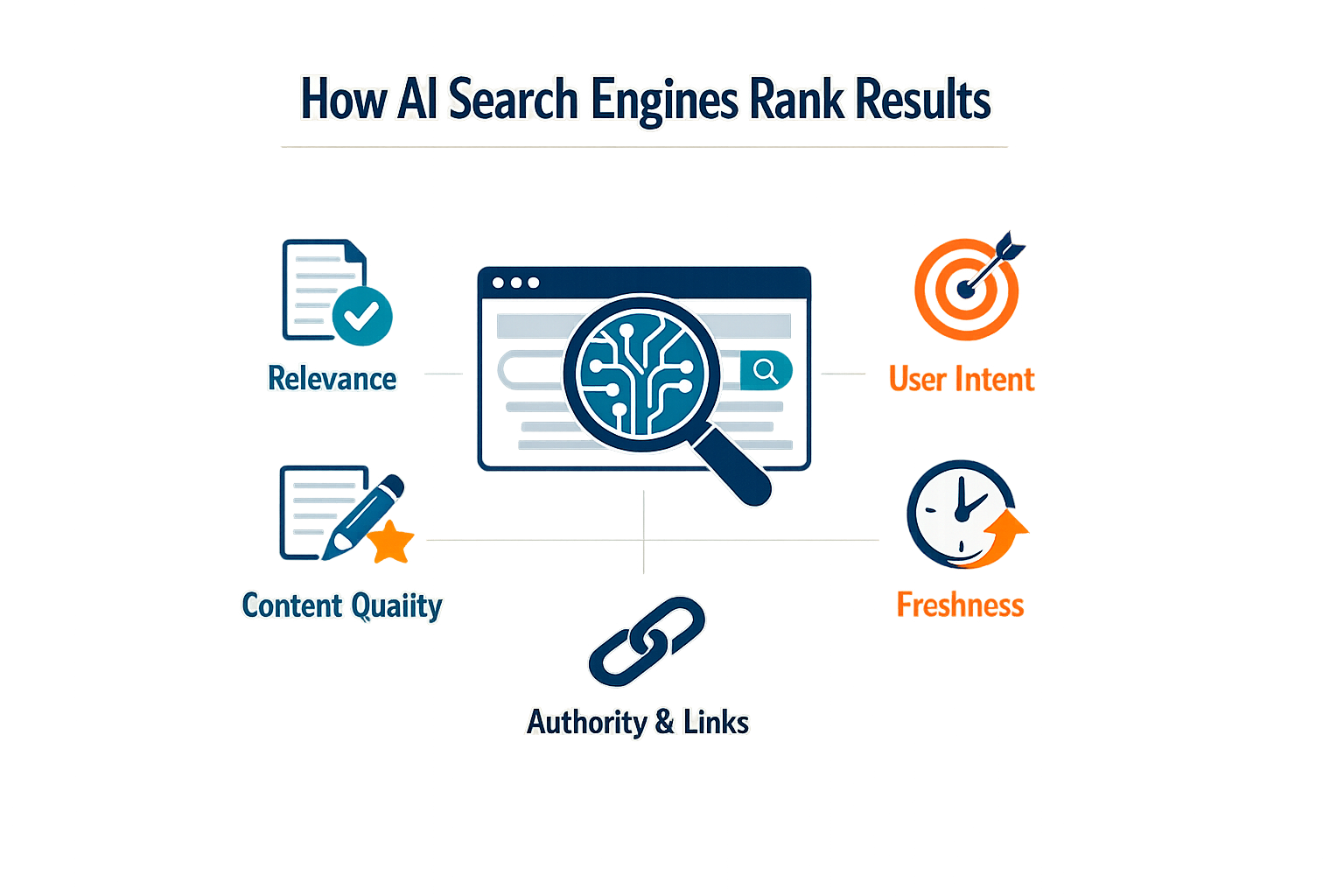
AI search engines work differently than traditional search. They don't just match keywords—they extract, synthesize, and present answers directly. When someone asks a question, the system routes the query to models trained to understand context, not just surface-level matches. The output is a generated answer, not a list of ten blue links.
AI search optimization is the practice of making your content retrievable, extractable, and citation-worthy in AI-powered answer systems. If your content isn't structured for extraction, it won't surface in AI-generated responses. The engine prioritizes sources it can parse cleanly and cite confidently.
What AI Search Engines Prioritize
AI systems favor content that's easy to interpret. Clear structure matters more than keyword density. The engine scans for factual statements, definitions, and step-by-step explanations it can pull verbatim or paraphrase with attribution.
Modern systems route prompts based on complexity. Simple queries hit lightweight models; nuanced questions get routed to deeper reasoning engines. Your content needs to satisfy both ends of that spectrum—quick facts for simple pulls, detailed reasoning for complex queries.
Authoritativeness still counts. The engine cross-references your claims against known sources. If your content contradicts established references or lacks supporting evidence, it gets deprioritized. Citations and structured markup signal that your content is grounded, not speculative.
How Retrieval Works in Practice
When an AI engine processes a query, it doesn't read your entire page. It scans for relevant sections using embeddings—mathematical representations of meaning. Content with clear topic boundaries and explicit headings gets indexed more accurately.
The engine pulls snippets that directly answer the query. If your explanation is buried in a long paragraph, it's harder to extract. Break information into discrete blocks. Use lists, callouts, and short paragraphs. The easier you make extraction, the more likely you are to get cited.
AI search optimization is the practice of making your content retrievable, extractable, and citation-worthy in AI-powered answer systems.
Understanding foundational AI systems matters if you're building content strategy for the long term. The landscape shifts as models improve, but the core principle holds: structure your content for machines first, readers second. Machines surface your content; readers decide if it's useful.
Key Factors for Ranking in AI
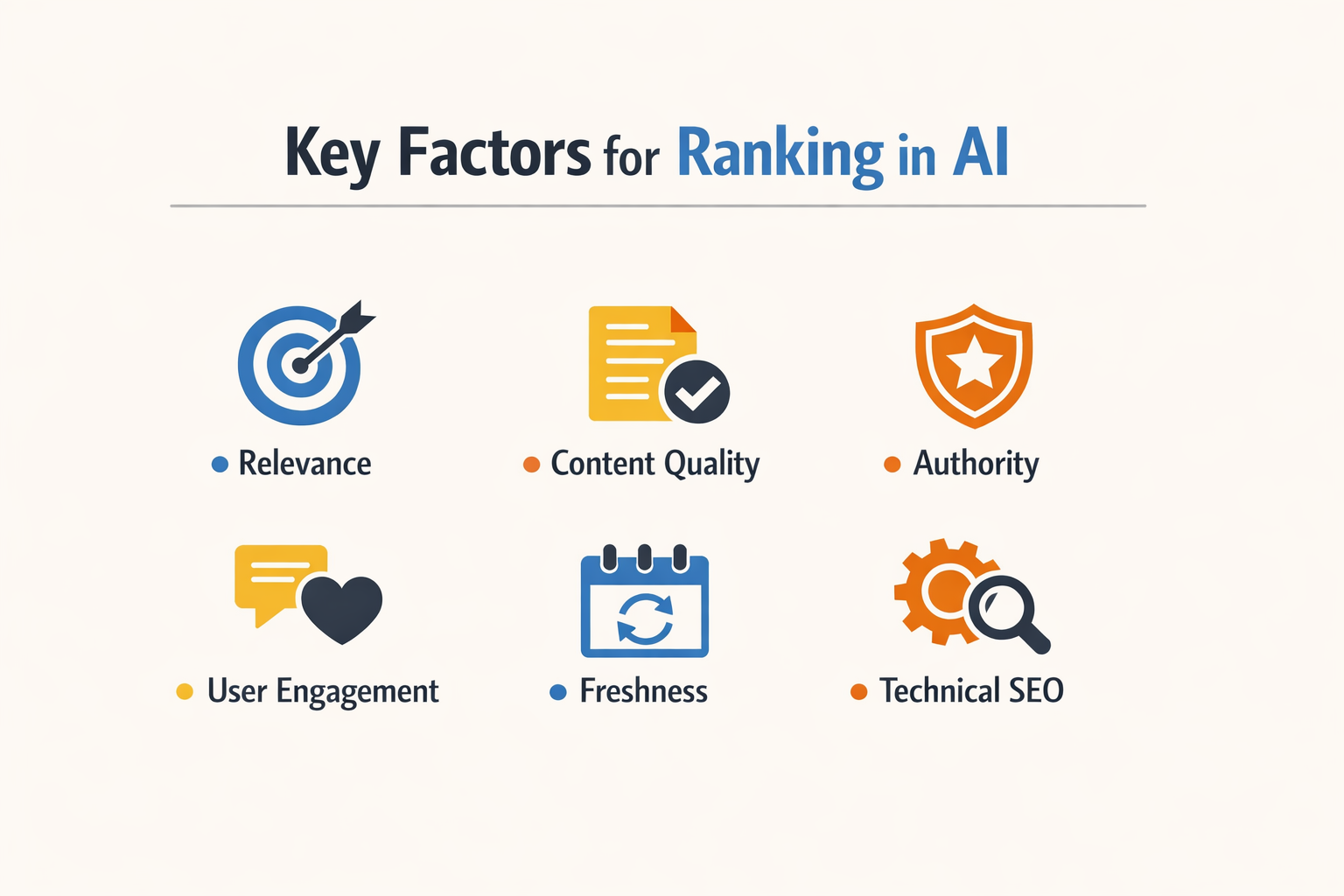
AI search engines evaluate content differently than traditional search. The factors that determine whether your content surfaces in AI-generated answers are specific and measurable.
Crawler Accessibility
Your site must be accessible to AI crawlers. Check your robots.txt file and confirm you're allowing bots like OAI-SearchBot and PerplexityBot. These crawlers power real-time AI answers. If they can't reach your content, you don't exist in AI search.
Most sites block these crawlers by default or through overly restrictive rules. A single misconfigured directive kills your visibility. Review your configuration line by line.
Content Structure and Authority
AI engines prioritize structured, authoritative content. This means clear headings, logical flow, and factual grounding. Vague claims and keyword stuffing don't work here.
The content must answer questions directly. AI models extract specific facts and relationships. If your content meanders or buries the answer three paragraphs deep, the model moves on.
Conversion Impact
AI search visitors convert at higher rates than standard organic traffic. In one measured case, AI visitors accounted for just 0.5% of total traffic but drove 12.1% of all signups — a conversion rate 23 times higher than traditional organic search.
AI search visitors convert at an average rate of 4.4 times higher than standard organic visitors.
This matters because it shifts the optimization goal. You're not chasing volume; you're chasing the right signal. A smaller number of AI-sourced visits can outperform thousands of generic organic sessions.
Structured Data Implementation
Structured data is non-negotiable. Schema markup tells AI engines what your content represents — whether it's a how-to guide, a product comparison, or a factual claim. Without it, the engine guesses. With it, you control the interpretation.
Implement schema types that match your content format. FAQ schema for question-answer pairs. HowTo schema for step-by-step guides. Article schema with author and publication metadata for editorial content.
Best Practices for Content Optimization
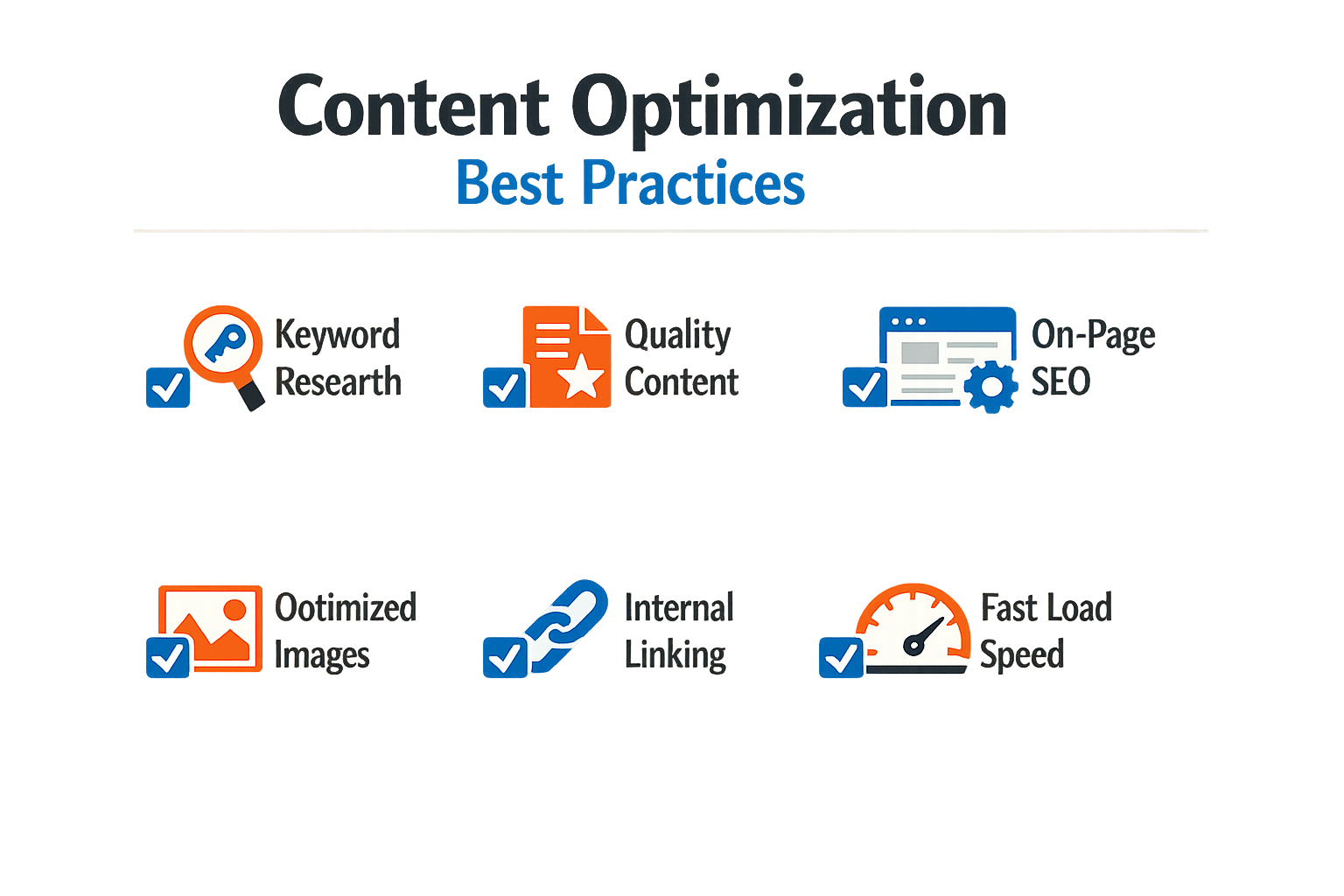
AI search engines extract answers from content differently than traditional crawlers. The machine reads every section independently, pulling citations from wherever it finds the clearest match to a user query. If your content buries the answer three paragraphs down, the LLM moves on.
Start Every Section with the Answer
Put the direct answer first. No preamble, no context-setting—just the answer to the question your heading implies. Research shows that 44.2% of all citations come from the first 30% of a document. Front-load the value.
Write each section so it can stand alone. An LLM doesn't read your intro or remember context from earlier sections. If Section 4 answers "How do I optimize images?", that section must contain everything needed to cite it: the method, the reason, the outcome.
Keep Answers Concise and Scannable
Short paragraphs win. Two to four sentences per block. Bullets when listing steps or criteria. The goal is not to write less—it's to make every sentence earn its place.
Avoid hedging language. "This approach may help improve rankings" is weaker than "This approach improves rankings." AI engines favor declarative statements over qualified ones.
Step 1
Audit your current content structure
Open five of your highest-traffic pages. Check whether each H2 or H3 section starts with a direct answer. If the first sentence is setup or background, rewrite it to lead with the answer.
Step 2
Rewrite headers as questions
Identify sections where user intent is a question. Change "Benefits of Schema Markup" to "Why Use Schema Markup?" The question format signals to the LLM that an answer follows immediately.
Step 3
Test section independence
Read each section in isolation. Can someone understand the answer without reading anything else on the page? If not, add the missing context to that section.
Structure for Machine Readability
Every section should be complete enough to answer the heading's implicit question. If your H2 is "How to Measure AI Visibility", the section must define the metric, explain the method, and state what success looks like. The LLM won't infer missing steps.
Use consistent formatting. If you list three criteria in bullets, don't switch to prose for the fourth. Machines parse patterns; inconsistency breaks the pattern.
The cheapest optimization is the one you can verify without waiting three months for ranking data.
Utilizing Structured Data
Structured data is machine-readable markup that tells AI engines what your content means, not just what it says. When you add schema to a page, you're handing crawlers a labeled map instead of forcing them to guess. AI search engines use this markup to extract facts, build knowledge graphs, and decide whether your content answers a query with precision.
Making Your Site Crawlable by AI
Before structured data matters, AI crawlers need to reach your pages. Check your robots.txt file and confirm you're allowing bots like OAI-SearchBot and PerplexityBot — these agents power real-time AI answers. A single disallow rule can zero out your visibility in generative results, regardless of how good your schema is.
Schema Types That Move the Needle
Focus on schema that maps to common query patterns. Article, HowTo, FAQ, and Product schemas cover most content types. Use JSON-LD format — it's easier to validate and less prone to rendering conflicts than microdata. Each schema type should match the page's actual structure; marking a blog post as a Product confuses crawlers and dilutes trust signals.
Nested schema adds depth. An Article with an embedded FAQ block tells AI engines the page answers multiple related questions, increasing the chance it surfaces for long-tail queries. Keep nesting logical — don't force unrelated schema into a single page just to hit a count.
The schema you ship is a contract with the crawler: label it wrong and the engine ignores the page entirely.
Governance and Compliance Signals
AI engines increasingly weight trust and provenance. Governance frameworks like SOC 2 and ISO 27001 are becoming non-negotiable signals, especially in regulated verticals. When you publish content tied to compliance-heavy topics, schema that references certifications or data residency controls can differentiate you from competitors who skip the audit trail.
Structured data isn't just about discoverability — it's about proving your content comes from a source that follows documented standards. Crawlers parse these signals when deciding which pages to cite in generated answers.
Testing and Validation
Run schema through Google's Rich Results Test and Schema.org validator before deployment. Broken schema is worse than no schema — it signals sloppiness and can trigger manual review flags. Fix errors in staging, not production. Monitor Search Console for structured data warnings; a sudden spike usually means a template change broke markup sitewide.
Analyzing Competitors
Competitor analysis in AI search is different from traditional SEO. You're not just looking at who ranks for keywords — you're examining which content AI models choose to cite, summarize, or surface in generated responses. The 2026 AI landscape runs on specialized models competing for specific functions, not a single dominant engine. Your competitors aren't just websites; they're the sources AI systems trust.
Identify Who AI Engines Cite
Start by querying AI search tools with your target topics. Note which sources appear in citations, which get quoted verbatim, and which show up in multi-step reasoning chains. These are your real competitors. Track patterns: do certain domains dominate technical explanations? Do AI models prefer recent publications or established authorities? The gap between traditional search rankings and AI citations tells you where opportunity lives.
Run the same query across multiple AI models. Google Gemini 2.5 Pro leads the LMArena with an Elo score of 1452, while Claude 4.5 Sonnet scores 1448. Different models pull from different training data and retrieval systems. A source that Claude favors might not appear in Gemini results. Map these differences to understand which competitors own which AI channels.
Reverse-Engineer Competitor Content Structure
Pull the pages AI models cite most often. Examine their structured data implementation — schema markup, metadata, heading hierarchy. Look for patterns in how they present facts: do they use comparison tables? Do they cite primary sources inline? Do they structure procedural content as numbered steps?
Check their update frequency. AI systems weight recency differently than traditional search, but fresh content with current data points still wins. If a competitor updates quarterly with new statistics, you need a plan to match or exceed that cadence.
Measure Content Depth and Authority Signals
Count how many primary sources competitors reference per article. AI engines reward research-grounded content. A piece citing five authoritative sources outperforms one with generic claims, even if the generic piece ranks higher in traditional search. Track their citation diversity: academic papers, industry reports, government data, or just other blog posts?
Look at author credentials and entity associations. Content attributed to recognized experts or organizations with established authority gets preferential treatment. If your competitors publish under named authors with public track records, you need equivalent signals.
Track Performance Gaps
Build a simple matrix: competitor name, topics they cover, AI models that cite them, structured data types they use, update frequency. Overlay your own content against this map. The white space shows where you can compete. If no competitor owns a specific sub-topic in AI citations, that's your entry point.
Monitor changes over time. When a competitor's content starts appearing in new AI model outputs, pull their recent updates. They found something that works. Reverse-engineer it, then execute your own version faster and with better sourcing.
Measuring Success
AI search rankings don't follow the same metrics as traditional SEO. You need different instruments to know if your optimization work is actually moving the needle.
Track Conversion, Not Just Traffic
AI search visitors convert at dramatically different rates than organic search traffic. Recent data shows AI search visitors accounted for just 0.5% of total visitors, but drove 12.1% of all signups — a conversion rate 23 times higher than traditional organic search visitors. This means volume metrics alone will mislead you. A small trickle of AI referral traffic can outperform thousands of conventional search visits.
Set up separate conversion tracking for AI search referrals. Tag traffic from ChatGPT, Perplexity, and other AI engines distinctly in your analytics. Measure signup rates, demo requests, or purchase completions per source. If your AI traffic converts at 10x but represents 1% of volume, you're still looking at meaningful revenue impact.
Monitor Citation Frequency
AI engines cite sources when they answer queries. Your goal is to be cited, not just ranked. Track how often your content appears in AI-generated responses.
Manual spot-checking works at small scale: run your target queries weekly in multiple AI engines and log whether your content appears in the answer. For larger operations, build a query list that covers your core topics and automate the checks. Some emerging tools scrape AI engine results, but manual verification remains the most reliable method for now.
Count citations per query category. If you're cited in 60% of product comparison queries but 10% of how-to queries, you know where your structured data and authority signals are working.
Benchmark Against Baseline
Establish a baseline before you change anything. Record current citation rates, AI referral traffic, and conversion metrics for at least two weeks. Then implement one optimization at a time — structured data, content depth, source attribution — and measure the delta.
AI search is still moving fast. What works in January may not work in March. Monthly benchmarking lets you catch shifts before they cost you visibility. If citation rates drop 20% month-over-month, you need to investigate whether the engines changed their ranking logic or a competitor outmaneuvered you.
The metric that matters is whether the AI engine trusts your content enough to cite it when money is on the line.
Adjust Based on Evidence
Don't optimize in the dark. If a content change increases citations by 40%, do more of that. If adding FAQ schema had zero impact after four weeks, try a different structured data type.
Keep a change log. Note what you modified, when, and what the measured outcome was two weeks later. AI ranking factors are still opaque, but your own data will reveal patterns faster than waiting for official guidance.
The job market for AI expertise is expanding rapidly — AI engineer ranked as the fastest-growing job title in the United States heading into 2026, with postings up more than 100 percent year over year. The same growth dynamic applies to AI search: early movers who measure correctly will capture disproportionate value.
Common Mistakes to Avoid
Ranking in AI search requires discipline. Most failures trace to treating AI engines like traditional search — same tactics, same shortcuts, same assumptions. AI systems operate on probabilities, not keyword density. The outputs are rough drafts. The inputs leak into training cycles if you're careless. Here's what breaks and how to avoid it.
Treating AI Outputs as Final Copy
AI-generated content is a starting point, not a deliverable. Systems return probabilistic guesses based on training data. They don't verify facts, check dates, or confirm citations. Publishing raw output without manual validation creates liability.
Validate every claim. Cross-check numbers. Confirm sources exist and say what the AI claims they say. If you can't verify it in thirty seconds, cut it or rewrite it with a source you control.
Exposing Sensitive Data in Prompts
Every prompt you send is a potential disclosure. Vendor terms often allow training on user inputs. Even if they don't today, policies change. Treat prompts as public documents.
Use placeholders. Anonymize examples. Strip identifiers before feeding data into any AI tool. The cost of a leak is higher than the convenience of a detailed prompt.
Ignoring Structured Data Requirements
AI engines prioritize content they can parse cleanly. If your pages lack schema markup, you're invisible to systems that rely on structured signals. JSON-LD for articles, FAQs, and how-tos is table stakes.
Most sites skip this because it's tedious. That's the opportunity. Implement schema for every content type you publish. Test it with Google's Rich Results tool. If the validator throws errors, fix them before you publish.
Optimizing for Keywords Instead of Intent
Keyword stuffing doesn't work in AI search. Engines parse semantic meaning, not phrase frequency. Writing for exact-match keywords produces brittle content that ranks poorly when users ask questions in natural language.
Focus on answering the question behind the query. If someone searches "rank in AI," they want actionable steps, not a page that repeats the phrase twelve times. Structure content to address intent directly. Use headings that mirror how people ask questions.
Skipping Competitor Analysis
You can't outrank what you don't understand. Most teams publish without checking what already ranks. They guess at structure, guess at depth, guess at sources. Then they wonder why nothing moves.
Pull the top five results for your target query. Note their structure, word count, source density, and schema implementation. Identify gaps. Build something better in at least two dimensions — depth, clarity, or authority. If you're not measurably stronger, you won't displace what's already there.
Publishing Without Measurement Infrastructure
If you can't measure it, you can't improve it. Most teams publish content and hope. They don't track rankings, don't monitor citations, don't log which pages AI engines surface. When performance stalls, they have no data to diagnose why.
Set up tracking before you publish. Log rankings weekly. Monitor AI engine visibility with tools that capture LLM citations. Compare performance across content types. Use the data to refine your approach. The pattern that works for one topic may fail for another.
Who Should Choose What Strategy
Not every path to ranking in AI search results looks the same. Your starting position, resources, and domain expertise determine which optimization strategies deliver the fastest return.
Match Strategy to Your Situation
If you run a content operation with existing domain authority, prioritize structured data implementation and schema markup. You already have the raw material — articles, product pages, case studies — that AI engines scan. Adding JSON-LD schema to existing high-traffic pages costs little and surfaces your content in answer boxes faster than rewriting from scratch.
For small teams or solo operators without engineering support, focus on content optimization and E-E-A-T signals first. Write with clear headings, short paragraphs, and factual claims you can cite. AI engines reward clarity and authoritativeness over technical complexity. Build a portfolio of well-sourced articles before investing in advanced schema.
If you operate in a specialized field — legal, medical, finance — the domain-expert-plus-AI path works best. You don't need to become an engineer. Instead, become the most AI-capable person in your niche by understanding how generative engines interpret your field's terminology and structure. Use that knowledge to format your existing expertise in ways AI can parse and cite.
When to Layer Multiple Approaches
Large organizations with dedicated SEO and engineering teams should run parallel tracks: structured data deployment, content refresh cycles, and competitor gap analysis. You have the bandwidth to test schema variants, measure citation rates, and iterate quickly.
Startups and early-stage companies should sequence strategies instead. Start with content optimization to build a citation-worthy library, then add schema as traffic grows, then invest in measurement infrastructure once you have enough data to make decisions. Trying to do everything at once spreads resources too thin and delays results.
Avoid Strategy Mismatch
Don't copy a competitor's playbook without understanding their context. A Fortune 500 brand can rank with thin content because domain authority carries weight. You can't. A solo consultant can rank with deep, narrow expertise. A generalist content farm can't.
Pick the strategy that fits your actual position, not the one you wish you had.
Conclusion
Ranking in AI search results is not a side project — it's a core shift in how content gets discovered and cited. The strategies outlined here work because they address what AI engines actually prioritize: structured data, authoritative sourcing, clear entity relationships, and content that answers questions without forcing the user to hunt.
Start with the basics. Implement schema markup for your core entities. Build a research-grounded content process that moves from research to outline to published article with citations intact. Optimize for featured snippets and conversational queries — these are the raw material AI engines pull from. Track your presence in AI Overviews and zero-click results, not just traditional rankings.
The data is clear: by May 2025, nearly 69% of all searches ended without a click, and when AI Overviews are involved, that figure climbs to nearly 80%. Your content needs to perform in that environment, which means being cited and surfaced even when users never visit your site. At ScoreCraft, I built a scoring system that goes beyond traditional SEO tools precisely because AI visibility requires a different lens — one that weighs structured data, entity clarity, and source authority as first-class signals.
Pick one strategy from this guide and implement it this week. If you're starting from zero, add schema to your most important pages. If you already have structured data, audit your content for entity consistency and citation quality. The gap between those who rank in AI and those who don't is widening — but it's still early enough to close it with disciplined execution.
Related reading
GEO SEO: Generative Engine Optimization for AI Search Rankings