
Introduction
Content Optimization Tools promise to fix everything from crawl budget to AI citations. Most don't. The gap between marketing decks and production reality costs time and credibility.
I've spent twenty-five years watching enterprise software vendors sell features that don't map to operator workflows. The pattern holds in content optimization: vendors lead with dashboards and AI integrations while the actual work—managing crawl efficiency, consolidating URLs, maintaining accurate metadata—requires different primitives entirely.
The choice isn't between good tools and bad tools. It's between tools that fit how your team actually produces content and tools that require you to retrofit your process to match their assumptions. Google and Bing both state that existing SEO fundamentals continue to support visibility across traditional search and AI-powered experiences. Your tool should make those fundamentals easier to execute, not harder.
Workflow comes first. A tool that integrates cleanly into your content pipeline and surfaces the specific signals you need to act on—crawl waste, duplicate content, missing structured data—delivers more value than a feature-rich platform that sits outside your daily process. The best Content Optimization Tools are the ones your team uses without friction, not the ones with the longest capability matrix.
This guide walks through selecting tools based on what you actually do: how you create content, how you measure it, and how you fix it when it breaks. No feature bingo. No vendor rankings. Just a framework for matching tools to workflow so you ship better content faster. For a broader view of how these fundamentals apply to AI-powered search, see our guide on How to Rank in AI Search Results: A Practical Guide.
Problem Statement
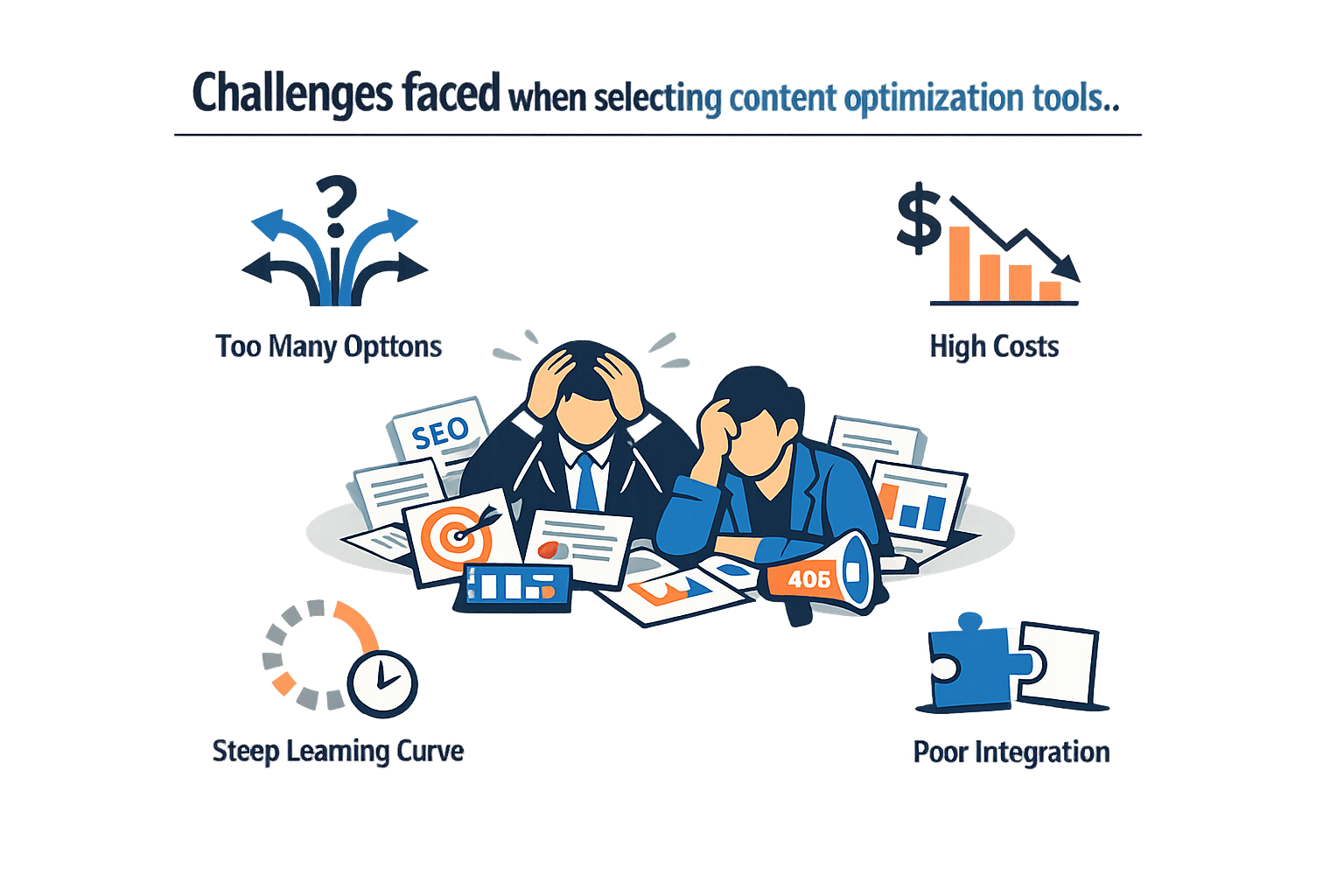
Most content teams pick tools the same way they pick lunch — whatever looked good in the last ad they saw. The market for content optimization tools runs on feature lists and promises, not on whether the tool actually fits the work you do every day.
The Feature-List Trap
Vendors sell capabilities. You need solutions to specific problems. A tool with forty features sounds impressive until you realize you only need three of them, and those three don't talk to your CMS without custom integration work that costs more than the annual license.
The disconnect gets worse when tools optimize for the wrong outcome. Search engines now explicitly prioritize people-first content over search engine-first content. A tool that pushes keyword density or word-count targets is optimizing for metrics that major search platforms have moved past.
Workflow Mismatch Costs Real Money
When a tool doesn't match your workflow, the friction shows up as time. Writers route around it. Editors duplicate effort. QA happens in spreadsheets instead of the platform you paid for.
Crawl efficiency and URL quality directly affect whether content gets indexed and remains retrievable. Tools that generate excessive low-value URLs or fail to manage duplication can delay indexing and reduce visibility across search experiences. The cost isn't just the license — it's the content that never surfaces because your tooling created crawl waste.
The Hype Cycle Accelerates Bad Decisions
Every six months a new category emerges. AI-powered this. Generative that. The underlying question stays the same: does this tool help you publish better content faster, or does it add another dashboard you check once and forget?
For a practical framework on optimizing for modern search experiences, see Building a GEO Strategy: Prioritizing Content for AI Answers.
The problem isn't that good tools don't exist. The problem is choosing them based on what they claim instead of what you actually need them to do.
Solution Steps
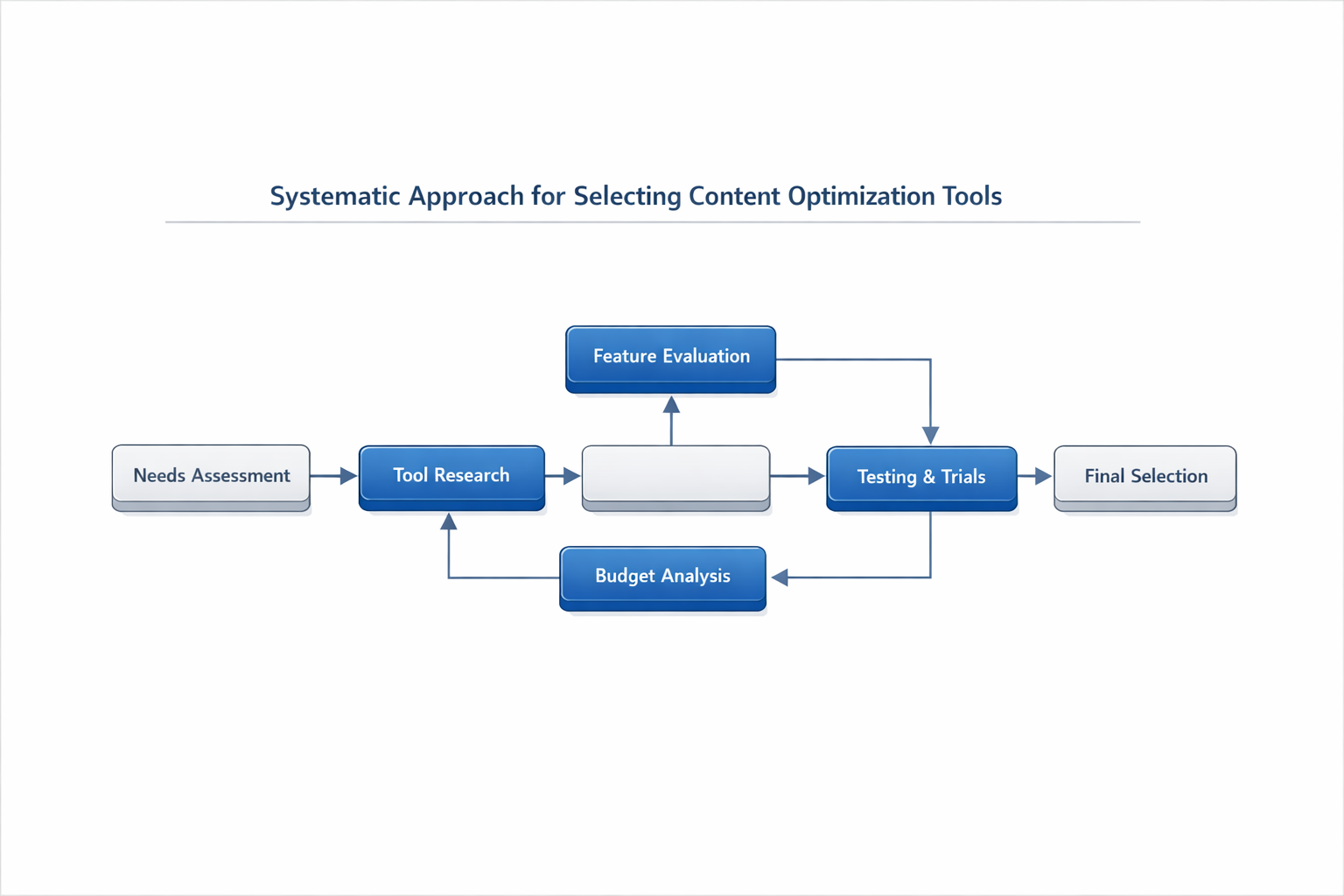
Selecting the right content optimization tools starts with mapping your actual workflow, not vendor promises. Here's the sequence that works.
Step 1
Inventory what you already publish
List every content type you produce: blog posts, landing pages, product descriptions, technical docs. Note the volume per month and who owns each type. If you publish 40 blog posts and 200 product pages monthly, your tooling needs differ from a team shipping 5 whitepapers per quarter.
Step 2
Identify the workflow bottleneck
Find where content stalls. Is it in drafting? Fact-checking? SEO review? Approval cycles? The tool you need solves the step that slows you down most. A keyword research platform won't help if your bottleneck is getting legal sign-off.
Step 3
Define measurable success criteria
Pick two to three metrics that matter for your content. Indexing speed, crawl efficiency, citation rate in AI answers, time from draft to publish. Avoid vanity metrics. If you can't measure it in your current stack, you won't measure it with a new tool either.
Match Tool Categories to Workflow Stages
Content optimization tools cluster into a few functional groups. Match them to where you actually need help.
Crawl and indexing tools manage how search engines discover and retrieve your content. They matter when you publish at volume or update frequently. Managing crawl efficiency and URL quality ensures important content stays indexed and retrievable, especially as search shifts toward grounding and citations.
Structured data and markup platforms add schema to pages. Useful if your content type benefits from rich results or if you need to signal entity relationships. Structured data may support clearer grounding, but it does not guarantee visibility. Markup must accurately reflect visible content.
Content scoring and readability analyzers flag unclear writing, keyword stuffing, or thin sections. They work best when paired with editorial judgment, not as pass/fail gates. A score of 68 versus 72 means nothing if the content doesn't satisfy user intent.
AI visibility and citation trackers measure whether your content appears in LLM-generated answers or Copilot grounding. If your goal is improving rankings in AI search results, these tools show which pages get cited and which don't. Content may surface as impressions, citations, or grounding references without a traditional click.
Step 4
Test with a small content set first
Pick 10 to 20 representative pages. Run them through the tool. Does it surface issues you didn't already know? Does it suggest changes you can actually implement? If the output is generic or requires a data science team to interpret, it's not a fit.
Step 5
Evaluate integration cost
Estimate setup time, training overhead, and ongoing maintenance. A tool that requires three weeks of onboarding and a dedicated operator costs more than its license fee. If it doesn't plug into your CMS or version control without custom dev work, factor that in.
Step 6
Run a retention decision at 90 days
Set a calendar reminder. At three months, ask: did this tool change a decision we made? Did it save time on a repeatable task? If the answer is no twice in a row, cancel it.
Tips and Tricks

The right tool won't fix a broken workflow. Start by documenting what you actually do — the handoffs, the approval gates, the places where content sits idle. Then map tools to those friction points, not to feature lists.
Verify Your Site Before Evaluating Tools
Before you evaluate any content optimization tool, verify your site in Search Console. You can't diagnose technical issues or measure tool impact without baseline visibility into crawl errors, indexing status, and performance data. Tools that promise optimization without access to your diagnostic data are selling you a dashboard, not a solution.
Test Against Real Editorial Decisions
Don't evaluate tools on sample content. Run them against pages you're actively revising or planning to publish. If a tool flags issues you already know about, it's not adding value. If it surfaces problems your team can't act on — because of brand guidelines, legal review, or resource constraints — it's generating noise, not signal.
Focus on people-first content creation. Tools that push keyword density or word-count targets without considering user intent will steer you toward content that satisfies algorithms but frustrates readers. The helpful content update penalizes exactly that trade-off.
Content may surface as impressions, citations, or grounding references without a traditional click — visibility exists beyond direct user interactions.
Measure Visibility Beyond Clicks
If you're optimizing for AI search or answer engines, traditional click-through metrics won't capture your results. Track citation appearances, grounding references, and impression data in Bing Webmaster Tools and Search Console. A tool that only reports on clicks is measuring the wrong outcome.
For a structured approach to prioritizing content for AI answers, see Building a GEO Strategy: Prioritizing Content for AI Answers.
Audit Tool Recommendations for Accuracy
When a tool suggests adding structured data or changing metadata, verify the recommendation against primary documentation. Markup that doesn't match visible content or title tags that misrepresent the page reduce indexing reliability and grounding eligibility. Tools that auto-generate schema without editorial review create compliance risk, not optimization.
Conclusion
Content optimization tools solve real problems when they match your workflow. The best tool is the one you'll actually use — the one that fits how your team already works, surfaces the data you need when you need it, and doesn't require three meetings to interpret the output.
I've spent twenty-five years in enterprise technology watching teams buy software they never deploy. The pattern is always the same: the demo looks great, the feature list is long, and six months later the license sits idle because nobody could figure out how to fold it into the daily routine. The tools that stick are the ones that answer a specific question your team asks every week.
Start with one workflow pain point. Pick the tool that solves it without creating two new problems. Measure whether it actually moves the metric you care about. If it doesn't, replace it.
The market will keep launching new platforms with bigger promises. Your job is to ignore the hype and ask whether the tool makes your content better, faster, or more visible. If the answer is no, the feature list doesn't matter.
For a broader view of how optimization fits into AI-driven search, see How to Rank in AI Search Results: A Practical Guide. The fundamentals don't change — clarity, accuracy, and structure still win. The tools just help you get there faster when they're the right fit for your process.
Related reading
AI Visibility Platforms vs Point Tools: Which Fits Your Team?