
Introduction
The difference between AI visibility platforms and point tools isn't philosophical. It's operational. Platforms handle nuanced questions that previously required multiple searches and return structured answers with supporting links. Point tools do one thing — schema validation, citation tracking, prompt optimization — and stop there.
I've watched teams pick platforms for the feature list, then spend six months wiring them into existing content pipelines. I've also watched teams cobble together five point tools, each solving a discrete problem, until the integration surface area became the problem. Neither path is inherently wrong. The question is which failure mode you can afford.
AI Mode in search engines now supports complex comparisons and exploratory queries in a single interaction. That shift changes what "visibility" means. You're no longer optimizing for ten blue links. You're optimizing for citation in a synthesized answer that may pull from three sources or thirty. Platforms promise to manage that complexity end-to-end. Point tools let you own each piece separately.
This article walks through the decision tree. We'll cover what each approach actually costs, where the hidden integration work lives, and how to match your tooling to your team's current capabilities. If you're trying to build a GEO strategy without clear tooling, you're building on sand.
What Defines Each Category
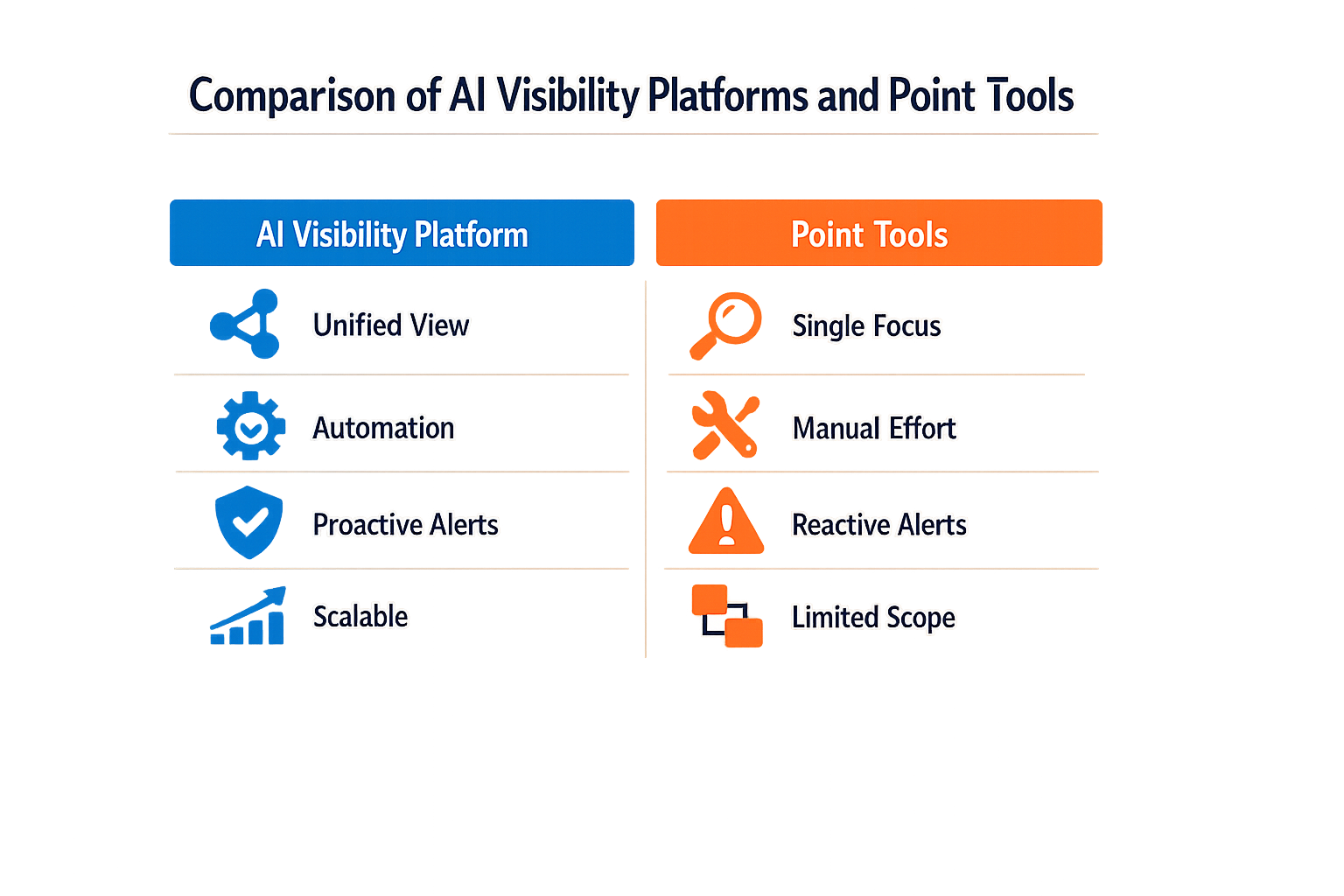
AI visibility platforms aggregate multiple functions: content scoring, schema generation, citation tracking, and performance measurement in one interface. Point tools isolate a single function. A platform might ingest your sitemap, score every page for AI readiness, generate structured data, and track which pages get cited in ChatGPT or Perplexity. A point tool validates your existing schema markup and stops.
The platform advantage is coherence. Data flows between modules without export-import friction. The point tool advantage is control. You pick best-of-breed for each function and accept the integration tax.
Neither approach eliminates the underlying work. You still need to fix thin content, add structured data, and measure citation rates. The tooling just changes who does the wiring.
Problem Statement
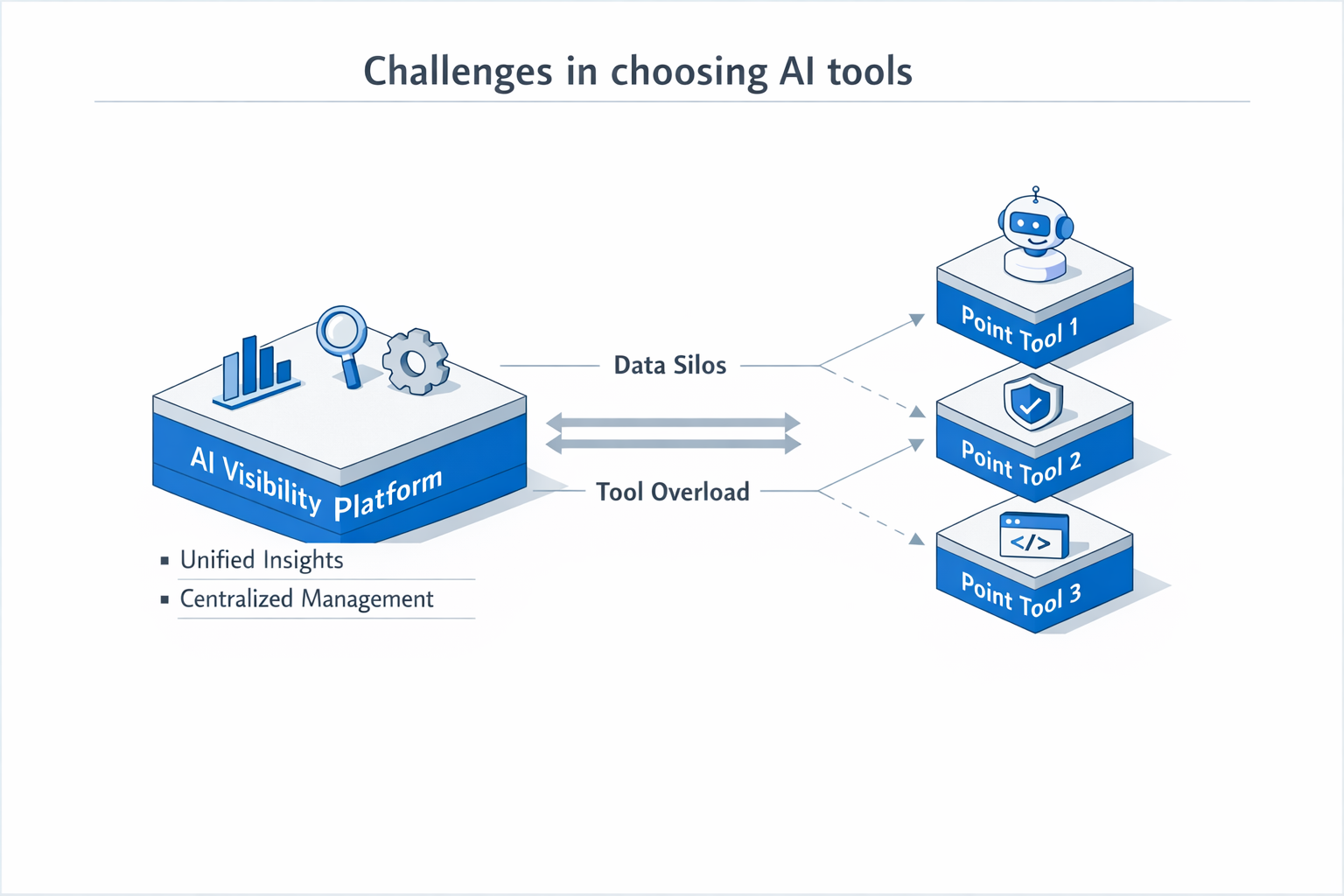
Teams building AI visibility capabilities face a decision that looks simple on paper but gets expensive fast: buy a platform that promises to do everything, or assemble point tools that each do one thing well.
The platform pitch is clean. One login, one dashboard, one invoice. The vendor handles integration, the data flows in a single direction, and nobody needs to write glue code. But platforms lock you into their roadmap. When they ship a feature you need six months late — or never — you wait or you bolt.
Point tools let you pick best-of-breed for each job. You want citation tracking from one vendor, schema validation from another, and query performance from a third — fine. But now you own the integration layer. Data moves between systems you maintain, not systems the vendor maintains. When a sync breaks at 2 a.m., it's your oncall engineer who fixes it.
The Real Cost Hides in the Handoffs
Most teams underestimate integration overhead. A platform charges you upfront in dollars and flexibility. Point tools charge you later in engineering time and operational complexity.
Semrush analyzed over 10 million keywords and tracked zero-click behavior shifts when AI Overviews appeared in search results. The study required combining keyword data, clickstream telemetry, and SERP feature detection across months of observation. That kind of longitudinal analysis works when your data lives in one system. When it's spread across three vendors with different export formats and refresh cycles, the analysis either takes longer or doesn't happen.
The cheapest tool is the one that ships the report your exec needs without a data engineering sprint.
Teams also misjudge skill requirements. Platforms assume you can click through a UI. Point tools assume you can read API docs, write transforms, and debug OAuth flows when they break. If your team has backend capacity and wants control, point tools make sense. If you're running lean and need answers tomorrow, a platform keeps you moving.
Visibility Needs Change Faster Than Contracts
AI search behavior shifts every quarter. Google rolls out AI Overviews to new query types. Perplexity changes how it weights citations. ChatGPT updates which schemas it respects. Your visibility strategy has to move with those changes.
Platforms update on their schedule. If a new AI feature launches and your platform doesn't support it for six months, you either wait or build a workaround with a point tool — now you're running both. Point tools ship faster but require you to track the changes yourself and rewire integrations when APIs evolve.
The decision isn't about which architecture is better in the abstract. It's about which failure mode your team can absorb. Platforms fail by locking you out of capabilities you need. Point tools fail by consuming engineering time you don't have. Pick the failure you can afford.
For teams evaluating how to build a GEO strategy that adapts to shifting AI behavior, the platform-versus-tools question determines whether you can act on new data in days or quarters.
Solution Steps
Step 1: Inventory Your Current Visibility Gaps
Start by cataloging where you lack visibility into AI-generated answers. Pull keyword lists from your existing analytics — queries driving traffic, queries you rank for, queries your competitors own. Run a sample set through a search interface that surfaces AI Overviews or answer-engine responses. Note which queries trigger AI results and which don't.
Document the gap between what you measure today and what you need to measure. If you track traditional SERP features but can't see citation patterns in AI answers, that's a gap. If you know your brand appears in ChatGPT responses but have no count or context, that's a gap. The inventory tells you whether you need one narrow fix or a broader measurement layer.
Step 1
Catalog your keyword universe
Export your top 500–1,000 keywords by traffic or strategic value. Run them through a tool that flags AI Overview triggers. Semrush analyzed over 200,000 keywords to understand AI impact — you don't need that scale, but you do need a representative sample that covers your core queries and a few edge cases.
Step 2: Define Your Measurement Scope
Decide what you actually need to track. If your goal is to monitor brand mentions in AI answers, a point tool that scrapes citation data might be enough. If you need to compare visibility across multiple engines — Google AI Overviews, Perplexity, ChatGPT search — you're looking at platform territory.
Write down the engines you care about, the query types that matter (informational, transactional, navigational), and the cadence you need (daily snapshots, weekly rollups, monthly audits). A single-engine, single-metric need fits a point tool. Multi-engine, multi-metric, or high-frequency tracking pushes you toward a platform.
Step 3: Evaluate Integration and Workflow Fit
Look at where the data needs to land. If your team lives in a single analytics dashboard and you just need one new metric, a point tool with an API or CSV export works. If you're stitching together SEO, content ops, and product analytics, a platform with native connectors or a unified schema saves time.
Ask whether the tool fits your existing stack or forces a new workflow. A point tool that requires manual uploads every week creates friction. A platform that auto-syncs but costs five times more creates budget friction. Map the integration cost — setup hours, maintenance overhead, training time — against the licensing delta.
Step 4: Test with a Pilot Keyword Set
Pick 50–100 keywords that represent your core visibility needs. Run them through both a point tool and a platform trial if you can get access. Compare coverage, accuracy, and the effort required to extract a useful insight.
Track how long it takes to answer a simple question: "Did our citation count in AI answers go up or down this month?" If the point tool gives you that answer in two clicks and the platform requires three dashboards and a custom report, the platform isn't adding value yet. If the platform surfaces a pattern the point tool missed — say, a competitor gaining ground in a specific query cluster — that's signal.
For teams serious about building a GEO strategy, the pilot reveals whether your measurement layer can keep pace with content iteration. If you're publishing optimized content weekly, you need visibility data that updates at the same cadence.
Step 2
Run a two-week pilot
Commit to a short evaluation window with real queries and real reporting needs. Don't test with dummy data. Use the keywords your team actually cares about, and try to answer the questions your stakeholders actually ask. The tool that makes that easy wins.
Step 5: Calculate Total Cost of Ownership
Add up licensing, integration labor, and ongoing maintenance. A point tool at $200/month that requires five hours of manual work each week costs more than a $1,200/month platform that runs unattended. Factor in the opportunity cost of your team's time.
If you're a small team with one person handling AI visibility part-time, a point tool that takes two hours a month to run is cheaper than a platform that takes two days to set up. If you're a larger operation with dedicated resources, the platform's upfront cost amortizes quickly.
| Factor | Point Tool | Platform |
|---|---|---|
| Licensing | $100–$500/month | $1,000–$5,000/month |
| Setup time | 1–4 hours | 1–3 days |
| Monthly maintenance | 2–10 hours | 0–2 hours (automated) |
| Integration complexity | Low (manual export) | Medium (API/webhook) |
| Multi-engine coverage | Single engine typical | Multi-engine standard |
Step 6: Make the Call and Set a Review Date
Choose the option that fits your current scope and budget, then set a calendar reminder to revisit the decision in 90 days. Needs change. A point tool that works today might not scale when you add three new content verticals next quarter. A platform that feels like overkill now might be exactly right when your traffic doubles.
Document why you chose what you chose — the gaps you prioritized, the integrations that mattered, the cost threshold that held. When you review in 90 days, you'll know whether those assumptions still hold or whether it's time to upgrade, downgrade, or pivot.
Tips and Tricks

Once you've chosen between a platform and point tools, implementation matters more than the decision itself. A platform configured poorly delivers less than point tools run well. Here's what works.
Start with One Measurement Surface
Don't instrument everything at once. Pick a single metric—citation rate in AI Overviews, or time-on-site from AI referrals—and get that measurement clean before adding more. Google Analytics tracks conversions and session duration alongside Search Console; use both if you're measuring engagement quality, but make one the primary lens for the first thirty days.
Platforms often bundle ten dashboards. Ignore nine of them until the first one drives a decision. Point-tool users face the opposite problem: each tool ships its own dashboard, and none talk to each other. Export to a shared sheet weekly until the pattern is obvious, then automate it.
Integrate Before You Optimize
AI visibility sits between content production and distribution. If your CMS, analytics, and schema tooling don't share a data model, every optimization is manual. Platforms promise to unify this; in practice, they do it for their own modules and leave your existing stack alone. Point tools never promise integration—you build it yourself or you don't get it.
The best setup is the one your team will actually keep current when someone goes on leave.
For platforms: confirm that your CMS webhooks trigger the platform's content scan without a manual sync step. For point tools: write the glue scripts now, while you remember why you picked each one. Three months later, no one will.
Don't Assume Expertise Scales Automatically
Some developers are comfortable reading performance signals; others find the volume of tools and metrics challenging to keep up with. Platforms reduce the learning curve by presenting a single interface, but they don't eliminate the need to understand what the numbers mean. Point tools assume expertise and punish teams that don't have it.
If your team is already fluent in structured data, Core Web Vitals, and LLM citation mechanics, point tools let you move faster. If half the team is still learning what schema markup does, a platform's unified vocabulary helps everyone speak the same language. Neither choice makes ignorance irrelevant—it just moves where the learning happens.
Audit Your Setup Every Quarter
AI search behavior shifts faster than traditional SEO. A citation pattern that worked in March breaks in June because a model updated its retrieval heuristic. Platforms update automatically, but their updates assume your content structure hasn't changed. Point tools stay stable, but you're responsible for noticing when the landscape moves.
Set a quarterly review: compare your citation rate, referral quality, and content coverage against the prior period. If a platform's new feature improved your visibility, document what changed. If a point tool stopped working, replace it before the gap becomes a crisis. The review takes an hour; skipping it costs you three months of drift.
Conclusion
The choice between AI Visibility Platforms vs Point Tools comes down to three variables: team size, the number of domains you operate, and whether you need a single source of truth or can manage data across disconnected systems.
Platforms make sense when you're tracking visibility across multiple properties or when attribution matters enough to justify the overhead. Point tools work when the problem is narrow — one domain, one channel, one person who can keep the spreadsheet updated.
I've built both kinds of systems. The platform route costs more upfront and takes longer to show ROI, but it scales without falling apart. Point tools ship faster and cost less, but every new domain or team member adds friction you can't automate away.
The data supports what most operators already know: AI Overviews now appear in a measurable share of high-volume queries, and when they do, position-one CTR drops by roughly 34.5%. That shift makes visibility measurement non-optional. Whether you measure it in a platform or a spreadsheet is a budget and headcount question, not a strategic one.
The right setup is the one you'll actually use when the next algorithm shift lands and you need an answer in the next two hours, not the next two weeks.
If you're still operating without structured tracking, start with a point tool and a clear definition of what constitutes a citation in your vertical. Once you know what you're measuring, the platform question answers itself. For teams building a GEO strategy, the platform investment pays back faster because the measurement layer feeds directly into content prioritization and schema decisions.
The landscape will keep shifting. The tooling that survives is the tooling that tells you what broke and how much it cost, fast enough to fix it before the next board deck.
Explore AI Visibility Platforms vs Point Tools to determine the best setup for your team. Analyze features, benefits, and fit.