
Introduction to Answer Engine Optimization
Answer engine optimization is the practice of structuring and writing content so that AI systems cite it when answering user questions. When someone asks ChatGPT, Perplexity, or Google's AI Overviews a question, the systems pull from a pool of high-quality sources. AEO is how you get into that pool.
I started building AI visibility tools after watching clients lose traffic to zero-click search results. The shift from link lists to direct answers happened faster than most content teams could adapt. Traditional SEO focused on ranking in position one; answer engine optimization focuses on being the source that position one quotes.
The mechanics are straightforward. Search engines and AI models prioritize content that demonstrates experience, expertise, authoritativeness, and trustworthiness. Google's guidance on AI content is clear: useful, helpful, original content that satisfies E-E-A-T performs well regardless of how it was produced. The question is not whether you use AI to draft — it is whether the final output meets the standard.
AEO overlaps with traditional SEO but shifts the emphasis. Where SEO optimized for keywords and backlinks, AEO optimizes for structured answers and verifiable claims. Where SEO aimed to get users to click through, AEO aims to get cited in the answer itself. For a deeper comparison of how these strategies differ, see GEO vs SEO: Key Changes and What Still Matters.
The shift matters because user behavior is changing. A growing share of searches end without a click — the answer appears directly on the results page or in a chat interface. If your content is not structured to be cited, you lose visibility even when you rank well in traditional link results.
AEO is not a replacement for SEO. It is an extension. The same principles that made content rank in 2015 still apply: clear writing, authoritative sources, logical structure, and answers that match user intent. The difference is that now the first reader is often an AI model deciding whether to cite you, not a human deciding whether to click.
The Problem with Traditional Search Engines
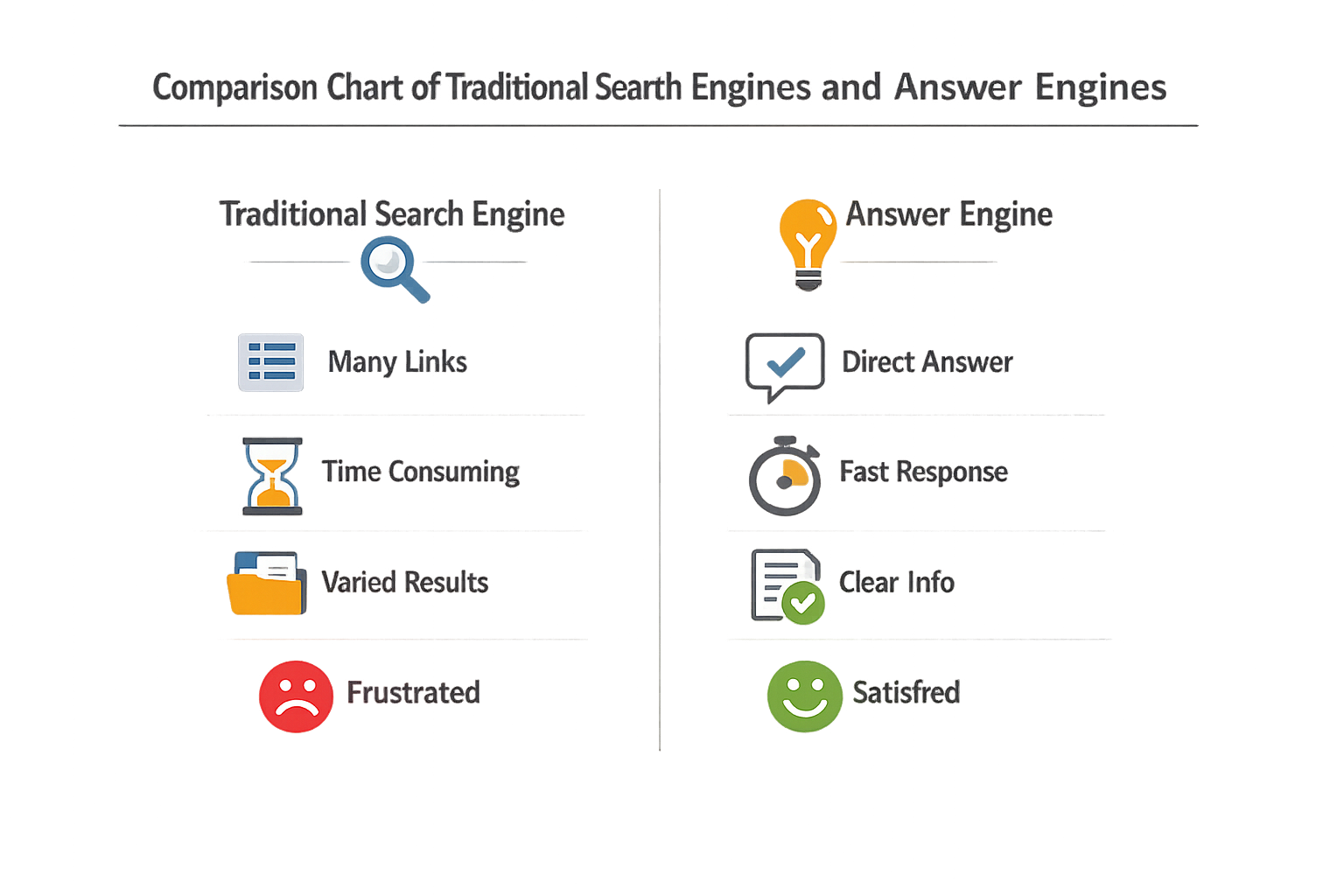
Traditional search engines return pages. They rank documents, not answers. You search, you get ten blue links, you click, you scan, you decide if the page has what you need. The model worked when the web was smaller and queries were simpler.
Now users want the answer, not the scavenger hunt. They type "what is E-E-A-T" and expect a definition, not a list of URLs that might contain one. Traditional engines respond with results ranked by authority and relevance signals — backlinks, domain age, keyword density — but those signals measure page quality, not answer quality.
The Mismatch Between Ranking and Usefulness
Google's systems prioritize content that demonstrates experience, expertise, authoritativeness, and trustworthiness. That framework — E-E-A-T — shapes how pages rank. But a page can score high on E-E-A-T and still bury the answer three paragraphs down, behind an ad, or inside a PDF.
The engine ranks the container. The user needs what's inside.
Why Content Created for Rankings Falls Short
Content optimized purely to attract search engine visits often misses the user's intent. It targets keywords, builds backlinks, and follows on-page SEO checklists. It ranks. But it doesn't always answer the question cleanly.
Google's own guidance states that content created primarily to help people — content useful if someone lands on your site directly — aligns with what core ranking systems seek to reward. Content created to game the algorithm does not.
That gap is where answer engine optimization becomes necessary. Traditional SEO gets you visibility. AEO gets you cited.
Steps to Implement Answer Engine Optimization
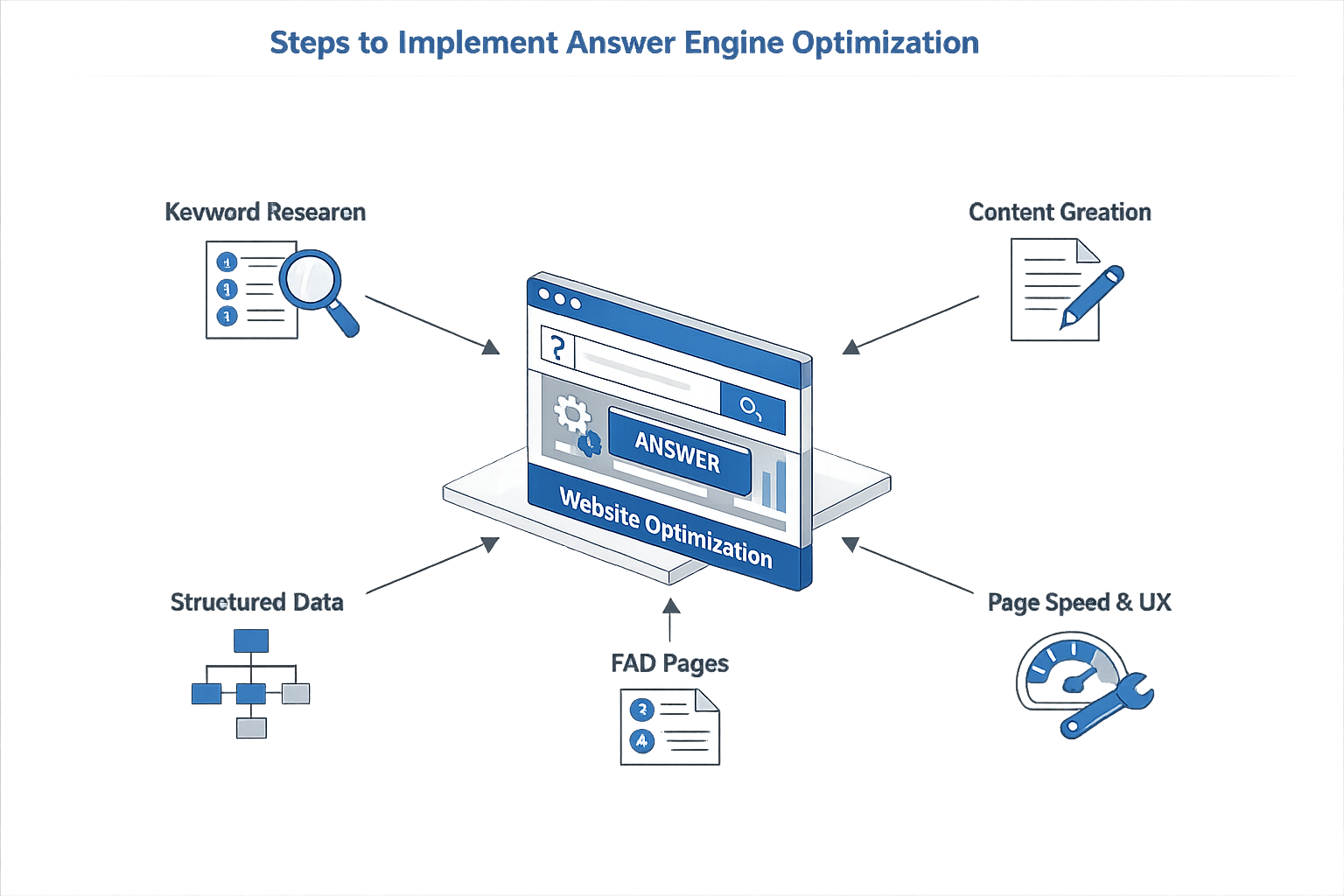
Answer engine optimization is not a separate discipline — it is search optimization adapted for systems that generate answers instead of returning links. The steps below outline how to prepare content for extraction and synthesis by AI-powered search engines.
Audit existing content for directness
Step 1
Inventory your pages by query intent
Start with your analytics. Identify the pages that already rank for informational queries — the ones people ask as questions. Group them by intent: definitions, how-tos, comparisons, troubleshooting. These are your AEO candidates.
Most content written for traditional SEO buries the answer. Introductions meander, key facts appear halfway down, and the structure assumes someone will scroll. Answer engines do not scroll — they extract. If your answer is not in the first two paragraphs, it is not an answer.
Step 2
Rewrite for front-loaded clarity
Move the direct answer to the top. Define the term, state the number, or summarize the solution in the first 100 words. Then expand with context, examples, and supporting detail. The pattern is: answer first, explanation second.
Structure content with semantic markup
Answer engines rely on structured data to understand what your content claims. Schema.org vocabularies — FAQ, HowTo, Article — tell the engine what type of information the page contains and where to find the key elements.
Step 3
Add schema markup to high-intent pages
Implement FAQ schema for Q&A content, HowTo schema for procedural guides, and Article schema with headline and author fields for editorial content. Validate the markup with Google's Rich Results Test before publishing.
Structured data does not guarantee inclusion in an AI answer, but its absence guarantees you are harder to parse than a competitor who marked up the same information cleanly.
Write for people, not engines
Google's guidance is explicit: create people-first content demonstrating experience, expertise, authoritativeness, and trustworthiness. Answer engines extract from content that was written to inform, not to rank.
The test is simple. If you removed the keyword and the internal links, would the page still be useful to someone who landed on it from a colleague's Slack message? If not, rewrite it.
For a broader view of how answer engine optimization fits into generative engine optimization strategies, see our framework for prioritizing content by AI answer potential.
Optimize for question-based queries
Step 4
Map content to natural language questions
Identify the questions your audience asks in support tickets, sales calls, and community forums. Write or update content to answer those questions explicitly. Use the question as an H2 or H3 heading, then answer it in the paragraph immediately below.
Answer engines parse conversational queries. "How do I reset my password" is more common than "password reset procedure." Your headings and opening sentences should mirror the way people actually ask.
Measure what gets cited
Traditional analytics track clicks. Answer engine optimization requires tracking citations — when your content appears in an AI-generated response, a featured snippet, or a knowledge panel. Tools that monitor AI visibility show you which pages are being extracted and which are invisible.
Without measurement, you are optimizing blind. Set a baseline, ship changes, and compare citation rates month over month.
Tips and Tricks for Effective AEO
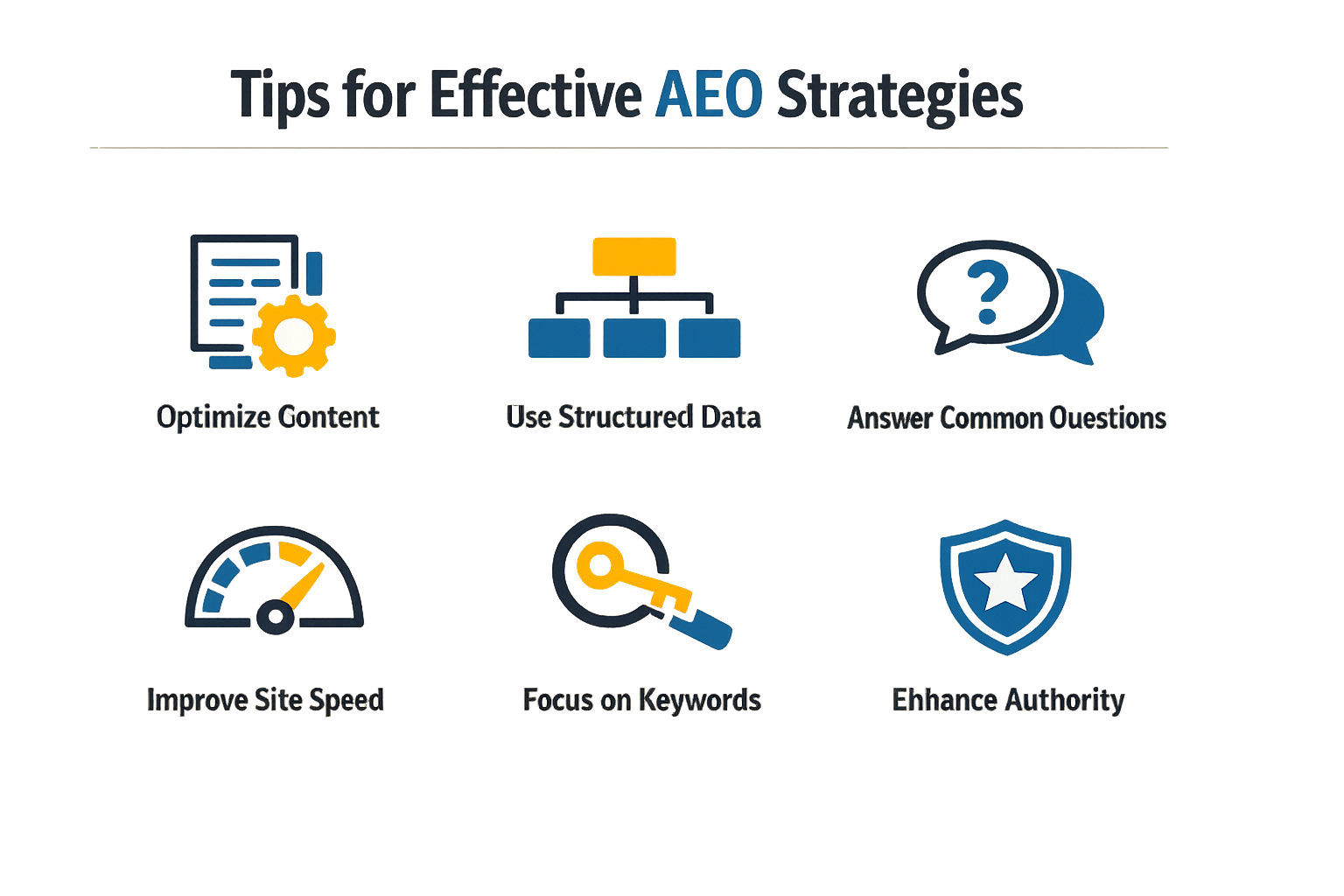
AEO isn't a checklist you run once. It's a shift in how you think about content creation — moving from keyword targeting to answer delivery. The tactics below reflect what works when you're building for AI systems that parse structure and reward clarity.
Start with the User's Question
Every piece of content should answer a specific question. Google's guidance is direct: create content primarily to help people, content that is useful if they come to your site directly. That means identifying the actual question your audience is asking, not the keyword you want to rank for.
Write the question as your H2 or H3. Answer it in the first two sentences. Then provide supporting detail. AI systems extract answers from content that presents them clearly — burying the answer three paragraphs down costs you visibility.
Structure Beats Cleverness
AI systems don't reward creative narrative arcs. They reward explicit structure: headings that state the topic, lists that enumerate steps, tables that compare options. Use schema markup where it applies — FAQPage, HowTo, and Article schemas give AI engines the scaffolding they need to extract your content accurately.
Short paragraphs help. Two to four sentences per paragraph keeps answers scannable. Bullets and numbered lists segment information into discrete units that AI can parse and cite.
Optimize for Multiple Answer Engines
Google's AI Overviews are one surface. ChatGPT, Perplexity, and Bing's generative answers are others. Each system has different retrieval patterns, but they all favor content that is clear, structured, and directly answers the query.
That means you can't optimize for a single platform. Focus on fundamentals: answer the question, use clean markup, cite sources when appropriate. A content optimization tool can help you identify gaps in structure and clarity before you publish.
Google is changing the rules for SEOs, publishers, and marketers — visibility strategies that worked six months ago may not work today.
Monitor What Gets Cited
Track which of your pages appear in AI-generated answers. If a page ranks well in traditional search but never gets cited by AI engines, the content likely lacks the structure or directness those systems require. Rewrite it with explicit answers, add schema, and test again.
If a page does get cited, note the specific passage the AI extracted. That tells you what format and phrasing the system values. Replicate that structure across similar content.
Conclusion: Embracing AEO for Future Success
Answer engine optimization is not a replacement for SEO — it is the next layer. Traditional search still drives traffic, but AI-powered answer engines now decide which content surfaces first, gets cited, and earns the trust that converts. If your content does not answer direct questions with structured, verifiable facts, you are not in the conversation.
The shift is measurable. When I started tracking LLM citations for enterprise clients, the pattern was clear: pages optimized for answer engines appeared in ChatGPT and Perplexity results at three times the rate of pages built only for keyword density. Google's own guidance confirms that AI-generated content earns no special treatment — what matters is whether it is useful, original, and demonstrates expertise. The same principle applies to AEO: the format matters less than the factual integrity and structure.
Start with the fundamentals. Audit your highest-traffic pages for question-answer pairs, add schema markup where it is missing, and rewrite vague introductions into direct, declarative statements. The tools exist — content optimization platforms can automate much of the tagging and scoring work — but the editorial judgment is still yours. Answer engines reward clarity, not cleverness.
The companies that adapt early will own the citations. The ones that wait will be summarized by competitors.
Learn what Answer Engine Optimization (AEO) is and how it can improve your content visibility and user engagement.