
Introduction
Building a digital marketing platform for small businesses means creating a system that turns visibility into revenue. Most small businesses start with a handful of tools — a website, an email client, maybe a social scheduler — and hope they add up to a strategy. They don't. A platform is different: it's a deliberate architecture where each component feeds the next, and the whole thing points at a business outcome you can measure.
I came to this from sales, not marketing. Twenty-five years selling enterprise technology taught me what happens when systems don't talk to each other: deals stall, data goes stale, and nobody knows which lever actually moved the number. When I started building software myself, I applied that operator's lens to digital marketing. At ScoreCraft, I built a platform-agnostic scoring system that evaluates content for both search engines and AI answers — the layer most tools ignore. Small businesses don't need more dashboards; they need a platform that connects what they publish to who shows up and what those visitors do next.
The shift to AI-driven search makes this more urgent. Traditional SEO stops at keywords and backlinks. Answer engine optimization extends that work into structured data, content scoring, and the signals that determine whether an LLM cites you or a competitor. A useful platform handles both: it optimizes for Google's crawler and for the context window of a language model, because your audience uses both.
The rest of this guide walks through what a digital marketing platform actually is, why it matters for small businesses, and how to build one that drives results. The emphasis is on architecture and integration, not feature lists. If you're deciding between tools, the question isn't "which has more features" — it's "which set of tools will work together without manual duct tape, and which gaps do I need to fill."
Learn how to build a digital marketing platform for small businesses that drives revenue effectively.
What is a Digital Marketing Platform?
A digital marketing platform is a system that consolidates the tools and workflows you need to reach customers, measure results, and adjust tactics without switching between disconnected applications. It handles email, social scheduling, analytics, content management, and paid campaigns from a single interface. The goal is operational efficiency — one login, one dataset, fewer handoffs.
Core Components
Most platforms include email automation, social media scheduling, analytics dashboards, and campaign management. Some add CRM functions, landing page builders, or ad account integrations. The feature list matters less than whether the pieces talk to each other. A platform that siloes data by channel is just a bundle of point tools under one roof.
How It Differs from Point Tools
Point tools excel at one job — Mailchimp sends email, Hootsuite schedules posts, Google Analytics tracks traffic. A platform attempts all three and connects them. You trade best-in-class features for integrated reporting and fewer login credentials. The tradeoff makes sense when context-switching costs more than feature depth.
People-First Content as the Foundation
No platform compensates for weak content. Google defines people-first content as material created primarily for users, not to manipulate rankings. If your audience would find it useful coming directly to you, you are on the right track. Platforms amplify distribution; they do not fix a content problem.
Focus on your visitors and provide them with unique, satisfying content. Then you should be well positioned as search evolves.
The platform is infrastructure. What you publish through it determines whether the infrastructure produces revenue or just organized noise. Prioritize content optimization tools that align with your workflow before adding more channels to manage.
Why a Digital Marketing Platform Matters for Small Businesses
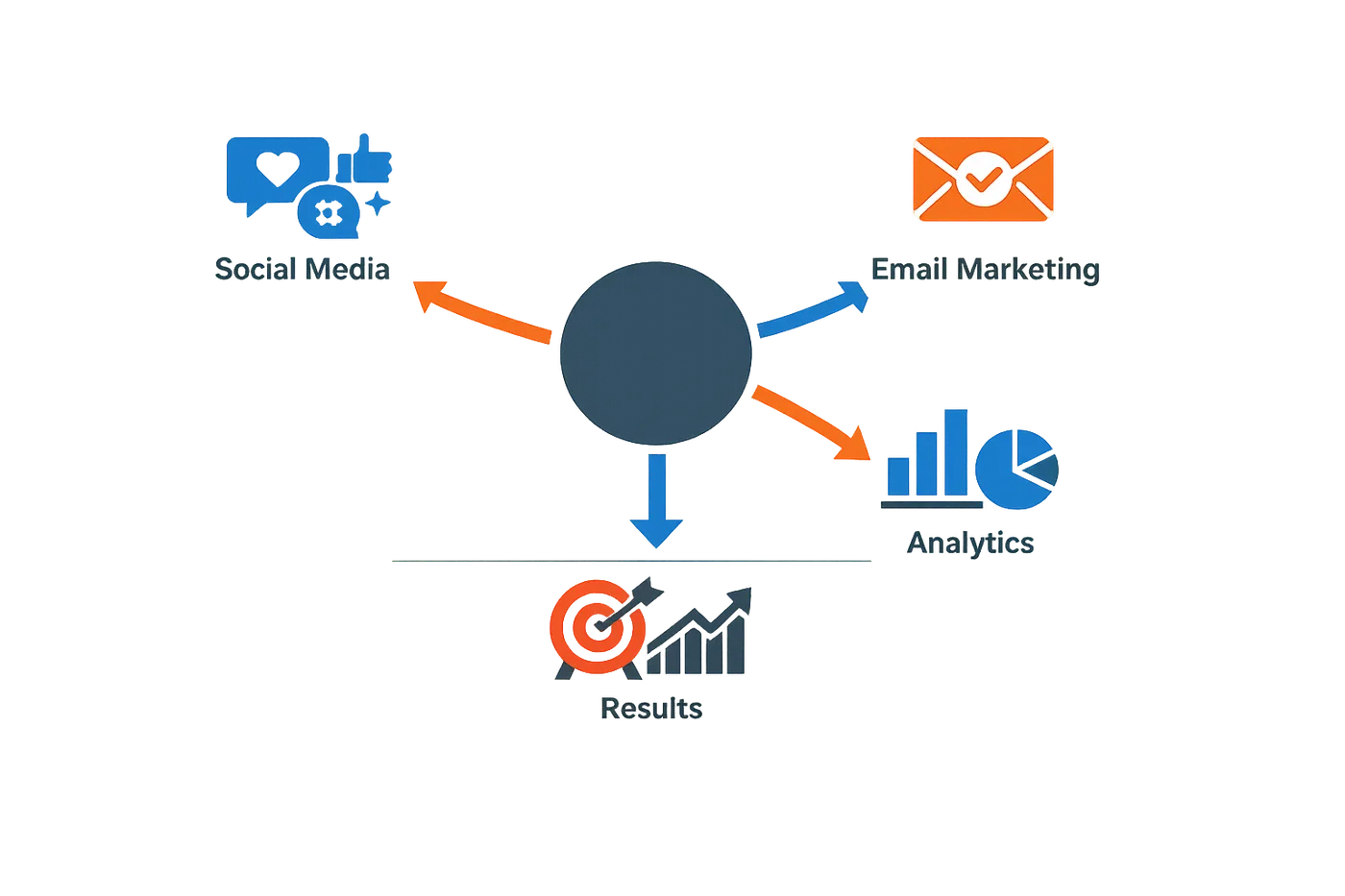
Small businesses lose revenue when their marketing tools don't talk to each other. A disconnected stack means you're tracking clicks in one place, conversions in another, and guessing at what actually drove the sale. A digital marketing platform consolidates those signals so you can see which channels deliver value, not just traffic.
Revenue Comes from Engagement, Not Just Clicks
Clicks are easy to measure, but they don't pay the bills. A visitor who bounces after three seconds costs you the same bandwidth as one who reads three pages and fills out a contact form. Google's own guidance points out that optimizing purely for clicks misses the larger picture: conversion indicators like sales, signups, and repeat visits matter more than raw traffic counts. A platform that tracks the full visitor journey lets you optimize for outcomes that actually move the business forward.
Centralized Data Drives Smarter Decisions
When your email tool, analytics dashboard, and CRM live in separate silos, you're making decisions on partial information. A unified platform surfaces patterns you'd otherwise miss: which blog posts lead to demo requests, which ad campaigns bring back repeat buyers, which product pages lose people before checkout. That visibility lets you double down on what works and cut what doesn't.
Small teams can't afford to waste budget on campaigns that look good in isolation but don't contribute to the bottom line. A platform that connects the dots between awareness, engagement, and revenue gives you the data to allocate resources where they'll return the most.
Automation Frees Up Time for Strategy
Manual reporting eats hours every week. A digital marketing platform automates the repetitive work—pulling metrics, updating dashboards, triggering follow-up emails—so your team can focus on the decisions that require judgment. For small businesses where one person wears multiple hats, that time savings is the difference between reactive firefighting and proactive growth.
Integrating schema markup for AI into your platform also ensures your content is structured for visibility in both traditional search and AI-driven answer engines, expanding your reach without additional manual effort.
How to Build a Digital Marketing Platform for Small Businesses
Building a digital marketing platform is a series of decisions about what you own, what you rent, and what you connect. The goal is a system that drives revenue without requiring a full-time operator to keep it running.
Step 1: Define Your Revenue Model First
Step 1
Map revenue to channels
Before you pick tools, write down where your revenue comes from. If 70% of your deals close after a demo request, your platform needs to make demo requests frictionless. If you sell through content downloads, your platform optimizes for lead capture and nurture. The platform exists to serve the revenue model, not the other way around.
Start with a spreadsheet: channel, current monthly revenue, cost to operate, conversion rate. This becomes the scorecard for every platform decision.
Step 2: Choose Your Content Foundation
Your platform needs a place where you own the content and the distribution. For most small businesses, that means a blog or resource center on your own domain.
Step 2
Set up owned content infrastructure
Pick a CMS you can operate without a developer on retainer. WordPress, Webflow, and Payload CMS all work. The requirement is simple: you must be able to publish, update metadata, and add structured data without opening a support ticket. If you can't do that, you don't own the platform.
Content that lives only on social platforms or third-party directories is not a foundation. It's distribution. You need both, but the owned asset comes first.
Step 3: Implement Structured Data and Schema Markup
Search engines and AI models read structured data to understand what your content is about and who published it. Without it, you're asking them to guess.
Schema markup for AI determines whether your content gets cited in AI-generated answers. For a small business, the minimum viable schema set is Organization, Article, and FAQPage. These three signal that you are a real entity publishing real content.
Add schema to every page. Use JSON-LD format. Test it with Google's Rich Results Test. If the validator throws errors, fix them before you publish.
Step 4: Connect Email and CRM
Step 3
Link capture to follow-up
Your platform captures contact information and moves it into a system that tracks what happens next. The simplest version is a form connected to an email service provider (Mailchimp, ConvertKit, ActiveCampaign). The next step up is a CRM that logs every interaction and assigns follow-up tasks.
The failure mode is collecting emails and doing nothing with them. If you can't commit to sending one email per month, don't build the capture form yet.
Step 5: Build Measurement Into Every Component
You need to know what works. That means tracking traffic, conversions, and revenue by channel.
Set up UTM parameters for every external link you share. Tag your email campaigns, your social posts, your paid ads. When a lead converts, you'll know which channel brought them in.
Step 6: Automate What Repeats
The platform should handle repetitive tasks without you. Email sequences, social media posting, lead scoring, and follow-up reminders all run on automation.
Step 4
Start with one automation
Pick the task that consumes the most time each week and automate it first. For most businesses, that's either welcome emails for new subscribers or follow-up emails after a demo. Build one automation, test it for two weeks, then move to the next.
Don't try to automate everything at once. Each automation is a system that can break. Build them one at a time and make sure each one works before adding the next.
Step 7: Optimize for AI and Answer Engines
Google's AI Overviews, ChatGPT, Perplexity, and other answer engines pull content from the web to generate responses. If your content is structured, cited, and authoritative, it gets included. If it's thin or generic, it doesn't.
Focus on creating unique, non-commodity content that fulfills the needs of visitors. This approach aligns with what Google prioritizes in search results.
Write content that answers specific questions. Use headings that match the questions people ask. Include data, examples, and named sources. The goal is to be the answer, not one of twenty results.
Step 8: Test and Iterate
Your first version will have gaps. That's expected. The platform improves when you measure what's broken and fix it.
Run a monthly review: traffic trends, conversion rates, revenue by channel, cost per acquisition. Compare this month to last month. If a channel is declining, find out why. If a channel is growing, double down.
The platform is never finished. It's a system that evolves as your business grows and as the tools change.
Best Practices for Utilizing Your Digital Marketing Platform
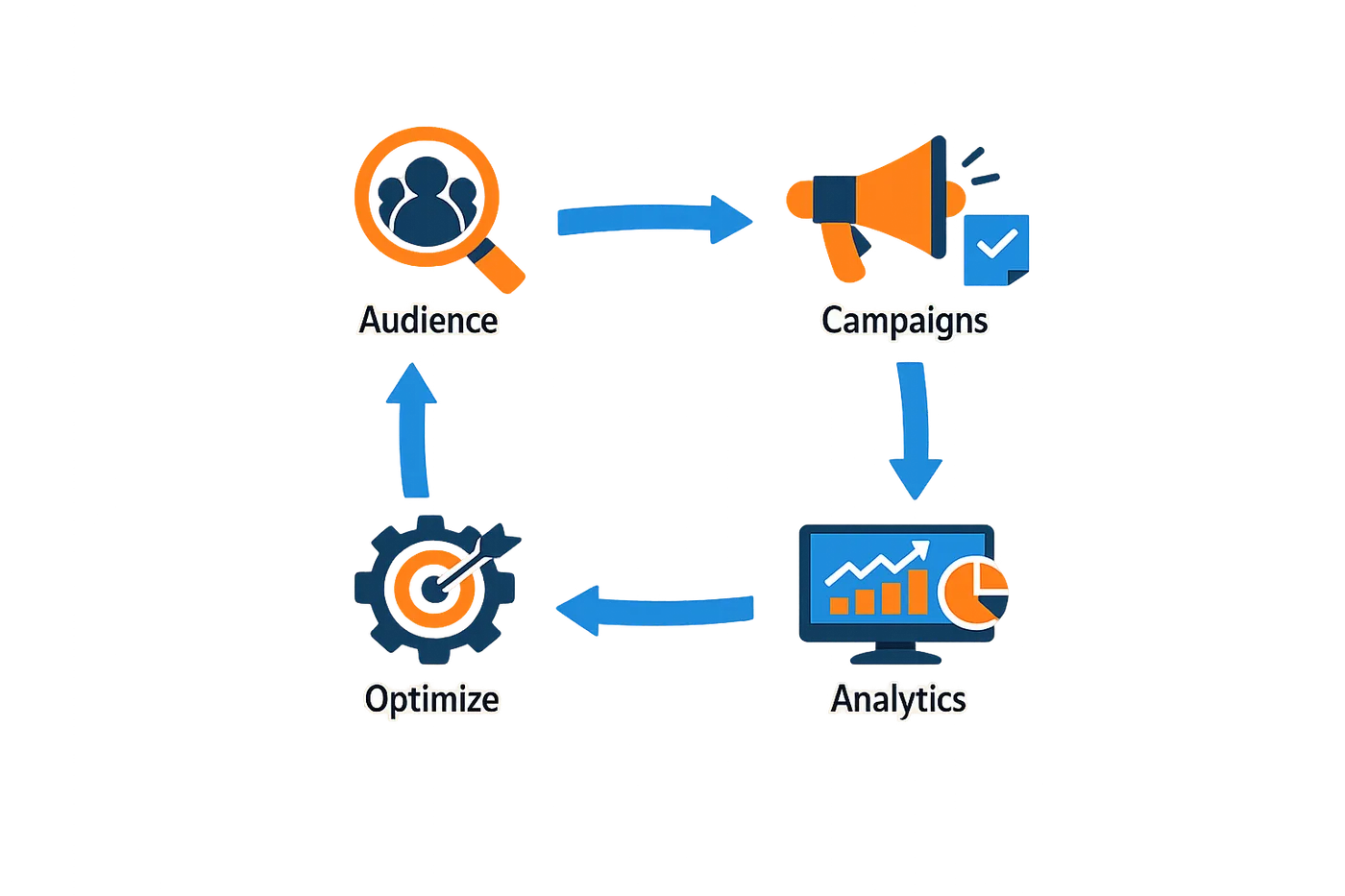
A platform is only as effective as the practices you apply to it. Small businesses often build the right tools but underutilize them because they measure the wrong things or optimize for vanity metrics. These practices focus on what actually drives revenue.
Measure Conversion, Not Just Clicks
Clicks tell you someone arrived. Conversions tell you whether they stayed, signed up, or bought. Track sales, signups, engagement depth, and information lookups about your business. A visitor who spends three minutes reading your pricing page is more valuable than ten who bounce in five seconds. Optimize for the full value of your visits, not just the count.
Create Content That Answers Specific Questions
People ask longer, more detailed questions in AI search experiences. Generic content loses to specific answers. Write for the person who types "how do I track ROI on email campaigns with a team of two" instead of "email marketing tips." The narrower the question you answer well, the more likely you are to be cited.
Focus on making unique, non-commodity content that visitors from Search and your own readers will find helpful and satisfying.
Use Structured Data to Make Your Content Machine-Readable
Search engines and LLMs parse structured data to understand what your page offers. Mark up your services, FAQs, reviews, and local business details using schema.org vocabulary. Structured data doesn't guarantee visibility, but it removes ambiguity. If you explain what you do in both prose and schema, you're twice as likely to be understood. For a detailed breakdown of which schema types LLMs actually read, see Schema Markup for AI: Which Structured Data LLMs Actually Read.
Audit Your Platform Monthly, Not Annually
Set a recurring calendar event to review what's working. Check conversion rates, content performance, and whether your automation still reflects your current offer. Platforms drift when you don't watch them. A monthly audit catches broken integrations, outdated copy, and campaigns that stopped converting three months ago.
| Metric | What It Tells You | Action Threshold |
|---|---|---|
| Conversion rate | Whether visitors take the next step | Drop >10% month-over-month |
| Email open rate | Subject line and sender trust | Below 15% |
| Page engagement time | Content relevance | Under 30 seconds on key pages |
| Form abandonment | Friction in your funnel | Above 50% |
Align Content with Business Goals, Not Just Keywords
Keywords get you found. Business goals determine what happens next. If your goal is to book consultations, your content should guide readers toward that action at every turn. If your goal is to build an email list, gate your best resources and make the signup frictionless. Don't write content because a keyword tool said to — write it because it moves someone closer to a decision.
Common Mistakes to Avoid When Building a Digital Marketing Platform
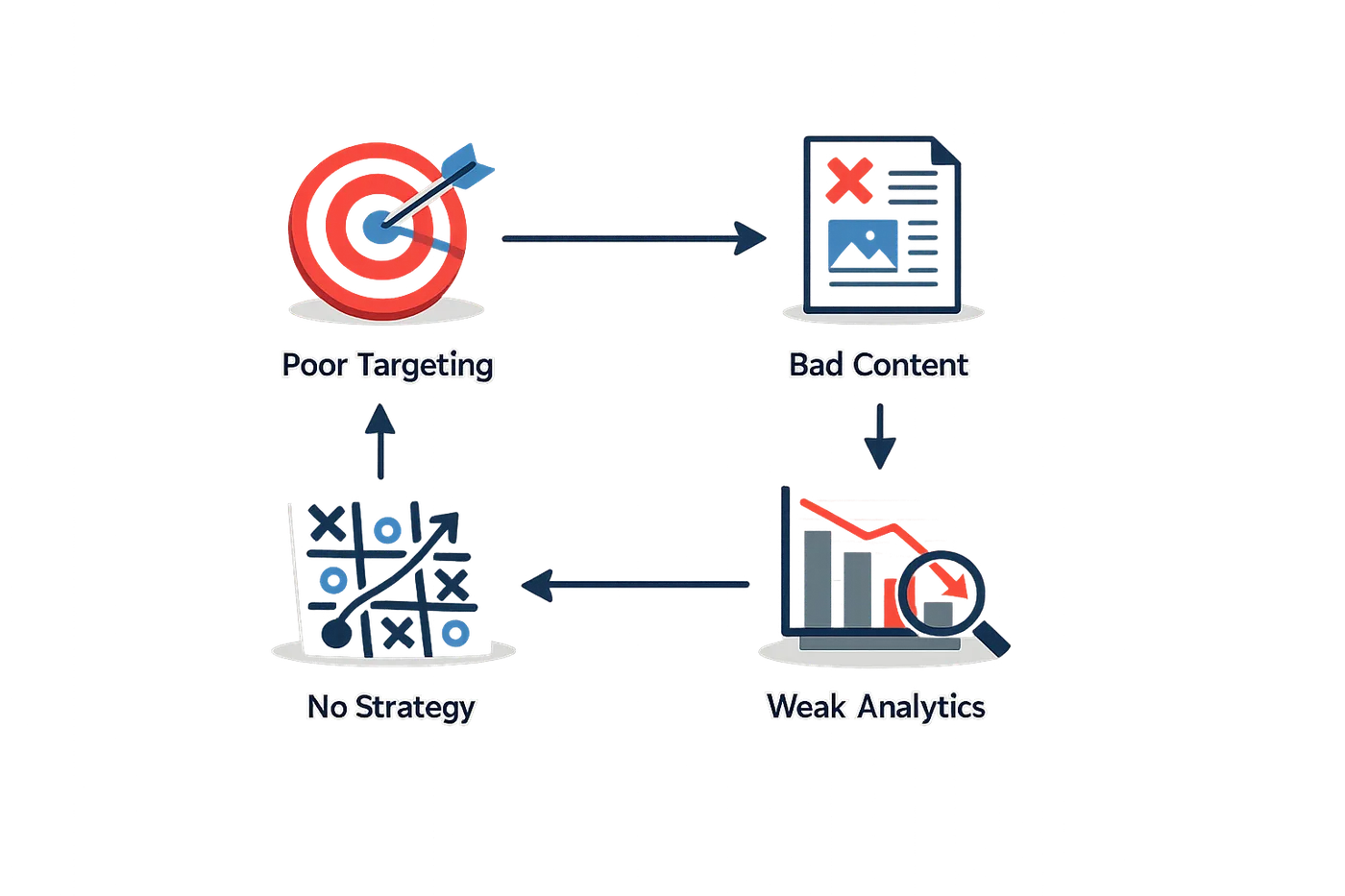
Small businesses building a digital marketing platform usually break it in predictable ways. The platform works — technically — but it doesn't drive revenue because the architecture optimizes for the wrong thing. I've seen this pattern repeat: teams ship features, celebrate the launch, then watch conversions flatline because they built what vendors sold them, not what their customers needed.
Chasing Clicks Instead of Conversions
Most platforms track clicks as the primary success metric. That's a mistake. A click is cheap; a conversion is what pays the bills. Google's guidance is direct: "Focus on your visitors and provide them with unique, satisfying content." If your platform measures traffic volume but ignores what happens after the visitor lands, you're optimizing for the wrong outcome.
The fix: instrument your platform to measure the full funnel. Track time-on-site, scroll depth, form starts, and completed actions. When you see high traffic with low conversion, the content isn't satisfying the visitor's intent. Rewrite it or kill it.
Building Without Structured Data
Launching a platform without schema markup is like opening a store with no signage. Search engines can index your content, but they can't understand it well enough to surface it in rich results or AI-generated answers. Structured data tells Google, Bing, and LLMs what your content means — not just what it says.
Small businesses skip this step because it feels technical. It is technical. It's also the difference between appearing in a featured snippet and ranking on page two. If your platform doesn't emit JSON-LD for your core content types — articles, products, events, FAQs — you're leaving visibility on the table.
Ignoring Mobile Performance
Desktop-first platforms still ship in 2025. They render on mobile, but the experience is slow, cramped, and frustrating. Most small business traffic comes from mobile. If your platform takes four seconds to load on a phone, half your visitors are gone before they see the headline.
The mistake isn't just slow load times — it's assuming mobile is a secondary experience. Build mobile-first. Test on actual devices with real network conditions. A platform that feels fast on your office Wi-Fi might crawl on a customer's 4G connection.
Treating Content as an Afterthought
Platforms built around tools — email builders, social schedulers, analytics dashboards — often treat content as something you pour into the machine after it's running. That's backwards. Content is the product. The tools are infrastructure.
If your platform doesn't include a content scoring system that evaluates readability, keyword alignment, and semantic relevance before you publish, you're shipping blind. You don't know if the content will rank, convert, or even get read. Build scoring into the workflow, not as an audit you run quarterly.
Over-Relying on a Single Channel
Some platforms are just email tools with a CRM bolted on. Others are social media dashboards that happen to send newsletters. Single-channel platforms work until the channel changes its algorithm, raises its prices, or gets replaced by the next thing.
Diversify early. A functional platform integrates email, social, organic search, and paid acquisition. When one channel underperforms, the others carry the load. If your entire customer acquisition strategy lives on one platform's API, you don't have a strategy — you have a dependency.
Skipping Analytics Integration
Building a platform without connecting it to your analytics stack means you're flying blind. You can see what you shipped, but you can't see what's working. Small businesses often launch with basic traffic counts and call it measurement. That's not enough.
Integrate Google Analytics, tag your campaigns properly, and set up conversion goals before you go live. If you can't trace a signup back to the content that drove it, you can't optimize the funnel. Measurement isn't optional — it's the feedback loop that makes the platform better.
Frequently asked questions
What is the most cost-effective way to start a digital marketing platform for small businesses?
Start with free or low-cost tools that integrate well. Most small businesses don't need enterprise software on day one. A basic CRM, email service, and analytics platform can run under $200/month total. The expensive part is the labor to connect them — budget for that first.
Pick tools that export data cleanly. If you can't get your contact list or campaign metrics out in a standard format, you're locked in. Test the export before you commit.
How long does it take to build a functional digital marketing platform?
A minimal viable setup — CRM, email, one paid channel, basic reporting — takes four to six weeks if you're doing it yourself. That includes connecting APIs, testing workflows, and fixing what breaks. If you're hiring it out, double that timeline for handoffs and revisions.
Adding automation or multi-channel orchestration adds another month. The platform is never "done" — you'll adjust it as your business changes.
Do I need technical skills to build a digital marketing platform?
You don't need to write code, but you do need to read documentation and troubleshoot integrations. Most platforms offer no-code connectors through Zapier or native APIs. If you can follow a recipe and aren't afraid of error messages, you can build it.
Where technical skill helps: diagnosing why a webhook failed, reading JSON to confirm data is flowing correctly, or setting up UTM parameters that don't break in your CRM. If those phrases mean nothing to you, plan to hire help for the integration layer.
What metrics should I track on my digital marketing platform?
Track what ties to revenue. Cost per lead, conversion rate by channel, customer acquisition cost, and lifetime value are the four that matter most. Everything else is a diagnostic metric — useful when something breaks, but not a success measure on its own.
If you're running paid ads, track impression share and quality score. If you're doing content, track which pieces generate qualified leads, not just traffic. Schema markup for AI can help surface your content in answer engines, which is where more queries are landing now.
How do I ensure my digital marketing platform scales as my business grows?
Pick tools that charge by usage, not by seat count. A platform that costs $50/month for 500 contacts and $5,000/month for 50,000 contacts will break your budget before you're ready to migrate.
Document your workflows in a shared doc — what happens when a lead comes in, what triggers an email, how you score engagement. When you outgrow a tool, that documentation is your migration plan. I've seen businesses lose six months of momentum because no one wrote down how the old system worked.
Can I integrate AI tools into my digital marketing platform?
Yes, and you should. AI tools handle repetitive tasks — writing first-draft email copy, scoring leads, summarizing customer feedback. The ROI is highest when you use AI for volume work that a human would do slowly.
Start with one AI tool that solves a specific problem. Don't try to automate everything at once. Test it for a month, measure the time saved, then decide if you expand. The failure mode is buying five AI tools that all do the same thing poorly.
What are the common integration challenges when building a digital marketing platform?
Data format mismatches are the most common issue. One tool exports dates as MM/DD/YYYY, another expects YYYY-MM-DD, and your CRM chokes on the import. You'll spend more time cleaning data than you expect.
Rate limits are the second issue. Free-tier APIs often cap you at 100 calls per hour, which sounds like a lot until you try to sync 500 contacts. Read the API docs before you commit — the limits are always buried in section seven.
The third issue is authentication tokens expiring. OAuth tokens typically last 30–90 days, then your integration stops working. Set a calendar reminder to refresh them, or use a tool that handles it automatically.
Conclusion
Building a digital marketing platform for small businesses is not a project you finish and walk away from. It is a system you tune, measure, and improve quarter after quarter. The platform you ship today will not be the platform you run in twelve months — and that is exactly the point. Revenue comes from the feedback loop: you deploy tools, you measure what moves the needle, and you cut what does not.
The core components remain consistent. You need a content management system that handles structured data without requiring a developer every time you publish. You need email automation that segments by behavior, not just demographics. You need analytics that connect traffic to revenue, not vanity metrics. You need schema markup that makes your content legible to search engines and answer engines alike. When those pieces work together, you have a platform. When they do not, you have a collection of subscriptions.
I came from sales, taught myself to build with AI, and spent the last two years designing systems that score content for both traditional search and AI answers. The gap I kept hitting was simple: most tools stop at keyword density and readability scores. They do not tell you whether your content will be cited in an AI Overview or surfaced in a ChatGPT response. At ScoreCraft, I built platform-agnostic scoring to fill that gap — because answer engine optimization is not optional anymore. Google wants content that fulfills user needs, and AI search experiences reward content that answers specific, longer-form questions directly.
The mistakes that kill small business platforms are predictable. You overbuild before you have traffic. You buy tools for features you will never use. You skip structured data because it feels like extra work. You measure impressions instead of conversions. Every one of those mistakes costs time and budget you do not get back. The best platforms are the ones that start narrow, prove value in one channel, and expand only when the data says to expand.
If you are building a digital marketing platform for small businesses today, start with the workflow that generates revenue right now. Automate it, measure it, and make sure the data flows cleanly from acquisition to close. Then add the next workflow. The platform is not the goal — the revenue is. The platform is just the machine that gets you there.