
Introduction
An online marketing platform is a software system that centralizes your digital marketing activities — email campaigns, social media management, analytics tracking, and content distribution — in one place. Choosing the right online marketing platform for small businesses means understanding which tools maximize visibility without draining your budget. Most businesses fixate on clicks and traffic numbers, but those metrics miss the larger picture. A platform that drives fewer visits with higher engagement often outperforms one that floods your analytics with bounces.
I built ScoreCraft to score content for both traditional SEO and generative engine optimization because small businesses need platform-agnostic measurement. Tools like Rank Math and Yoast stop at WordPress; that constraint becomes expensive when your stack evolves. At AboveNet I managed a $22M annual new-booking quota, which taught me that strategic allocation beats feature checklists every time.
The platforms worth your money deliver three things: measurable conversion paths, structured data support for AI search engines, and pricing that scales with your actual usage. Google's own guidance confirms that focusing on overall visit value rather than click volume produces better outcomes. Sales, signups, engaged sessions, and information lookups about your business all count as conversions—your platform needs to track them.
Budget-conscious platform selection starts with knowing what you need to measure. The next section breaks down the specific challenges businesses face when their requirements collide with pricing tiers and feature gates.
Problem Statement
Most businesses waste money on platforms they don't need because they optimize for clicks instead of outcomes. A platform with impressive traffic numbers means nothing if those visitors don't convert. The gap between what a tool promises and what it delivers shows up in your conversion data — sales, signups, engaged sessions — not in vanity metrics.
The shift to AI-driven search makes this worse. Google's AI Overviews now appear for millions of queries, changing how users find and interact with content. Industries see different impacts: some verticals lose visibility overnight while others gain new entry points. If you pick a platform based on last year's search behavior, you're building on sand.
The Real Cost of Platform Mismatch
Budget constraints force hard choices. A platform optimized for traditional SEO won't help you rank in ChatGPT or Perplexity. One that ignores structured data leaves you invisible to answer engines. The wrong choice doesn't just waste the subscription fee — it compounds over time as competitors adapt and you fall further behind.
Small businesses face a second problem: most platforms assume you have a dedicated team. They bundle features you'll never use and charge for scale you don't need. The result is overpaying for complexity while underfunding the channels that actually drive revenue. According to Gartner research, 43% of marketing technology investments go underutilized, representing significant wasted budget in the typical small business stack.
Solution Steps
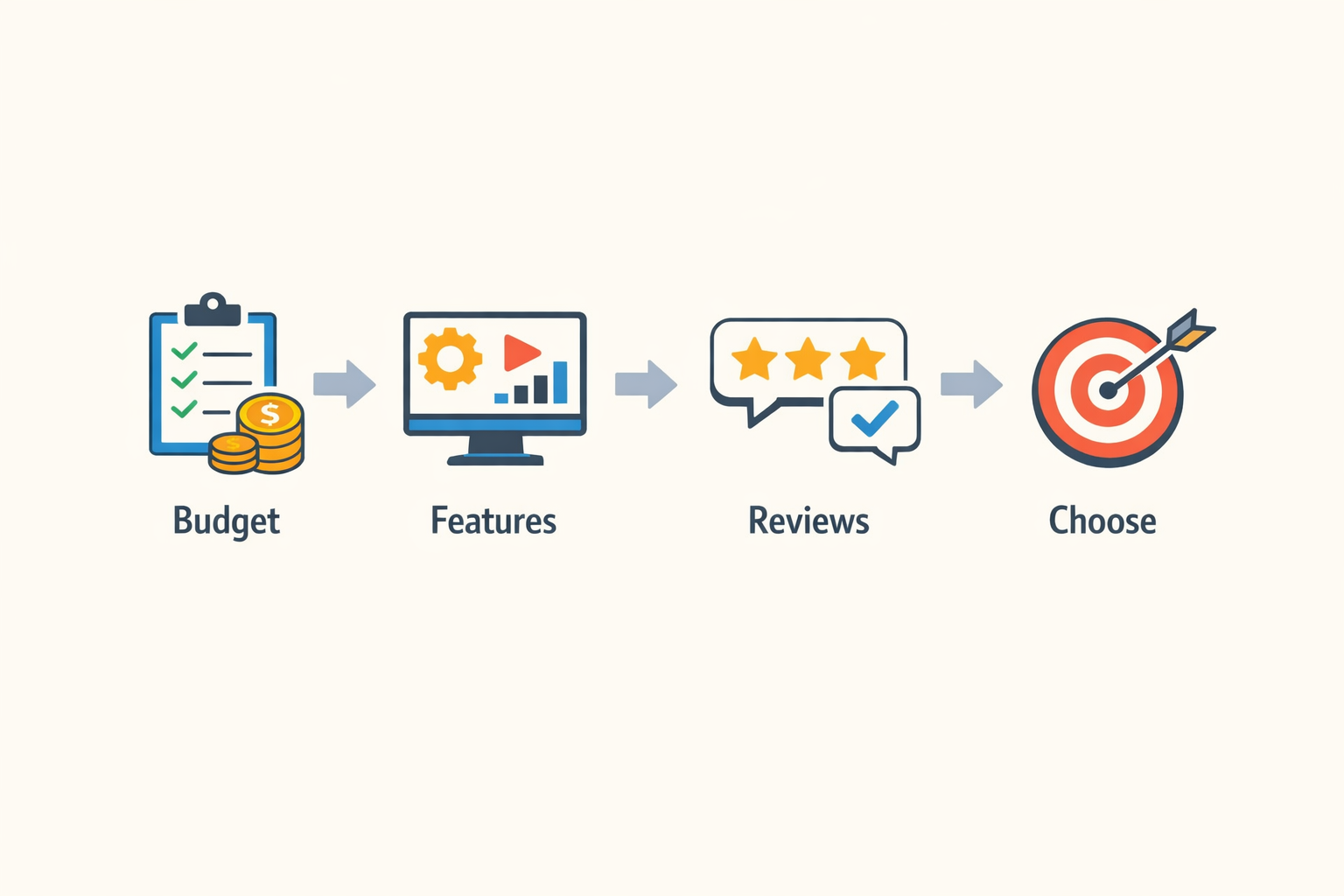
Choosing an online marketing platform for small businesses that fits your budget requires a methodical approach. These steps keep you focused on what delivers results rather than what looks impressive in a demo.
Step 1
Inventory your current marketing activities
List every marketing task you run today — email sends, social posts, landing pages, analytics checks. Note which tools you already pay for and what they actually do. This baseline tells you what a new platform must replace and what gaps it needs to fill.
Step 2
Define your budget ceiling and floor
Set a hard maximum you can afford monthly or annually. Then set a floor — the minimum spend that gets you real capability, not a crippled free tier. Most platforms price by contact count, user seats, or feature bundles. Know which pricing model fits your growth trajectory.
Step 3
Evaluate content quality and tracking capability
A platform's value depends on whether it helps you create content that performs. Assess whether the platform supports structured data, schema markup, and analytics integration. Tools like Google Analytics track conversions and time on site — metrics that matter when you're paying for visibility. Platforms that integrate these measurement layers let you see what's working without stitching together five separate dashboards.
Step 4
Test with a contained pilot
Run a 30- or 60-day pilot with a single campaign or product line. Set clear success criteria — lead volume, cost per acquisition, time saved. If the platform can't prove value in a controlled test, it won't prove value at scale.
Step 5
Compare total cost of ownership
Add up subscription fees, onboarding costs, training time, and integration work. A cheaper platform that requires three bolt-on tools and a part-time admin costs more than a pricier all-in-one that your team can run without help. Calculate the real annual outlay, not just the sticker price.
Align platform choice with visibility strategy
Once you've narrowed your options, map each platform's capabilities to your visibility goals. If you're optimizing for AI search engines and answer engines, the platform needs to support schema markup for AI and structured content workflows. Traditional SEO platforms often stop at keyword density; platforms built for modern search measure how well your content answers questions and surfaces in AI-generated results. Understanding GEO vs SEO helps clarify which platform capabilities matter most for your visibility strategy.
| Evaluation criterion | What to check | Why it matters |
|---|---|---|
| Analytics integration | Native connectors to Google Analytics, Search Console | Avoids manual data stitching |
| Structured data support | Schema.org markup, JSON-LD output | Required for AI visibility |
| Pricing model | Per-contact, per-user, flat-rate | Affects cost as you grow |
| Onboarding complexity | Self-serve vs. required consulting | Hidden time and labor cost |
The right platform fits your workflow today and scales without forcing a migration in twelve months. Prioritize platforms that expose performance data clearly and let you act on it without opening a support ticket.
Tips and Tricks
Most platforms look identical on the sales page. The difference shows up when you try to cancel, export your data, or scale past the initial tier.
Start with a trial that mirrors real use
Sign up for the free tier or trial and immediately load your actual contact list, not sample data. Send a real campaign to a small segment. Track whether the interface slows down with real volume, whether your IP gets flagged for deliverability issues, and whether the reporting gives you the numbers you actually need. If the trial restricts core features you'll use daily, that's a pricing red flag.
Prioritize platforms that publish their limits
The best platforms document API rate limits, storage caps, and feature restrictions in public documentation. When a vendor hides those numbers behind a sales call, assume the limits are tight and the upsell pressure is high. Transparent pricing and capacity documentation signal a platform built for operators, not just marketers.
Audit your content for people-first signals
Once you've chosen a platform, the content you produce matters more than the tool itself. People-first content means you're writing for an audience that would find the material useful if they came directly to you, not content engineered solely to manipulate rankings. Ask whether your existing or intended audience would value the piece on its own. If the answer is no, the platform won't fix it.
For teams working across traditional SEO and AI visibility, content optimization tools that score for both search engines and LLMs help maintain that people-first standard without manual guesswork.
Test integrations before you commit
Most platforms advertise hundreds of integrations. Connect your CRM, analytics tool, and payment processor during the trial. Confirm data flows both directions, that field mapping works without custom code, and that the sync runs on a schedule you can live with. An integration that requires Zapier or a developer to maintain is an integration you'll eventually abandon.
The cheapest platform is the one you can operate without opening a support ticket.
Plan your exit before you sign
Read the cancellation terms and the data export policy. Confirm you can download your full contact list, campaign history, and analytics in a portable format. Platforms that lock data behind a retention paywall or require a manual export request are betting you won't leave. That's a cost you pay later.
What Features Matter Most in an Online Marketing Platform?
The feature list matters less than how well those features match your workflow. Most small businesses need five core capabilities: email automation, landing page creation, contact segmentation, analytics integration, and mobile-responsive templates. Everything beyond that is either convenience or bloat, depending on whether you'll actually use it.
Email automation should let you trigger sequences based on user behavior — form submissions, link clicks, purchase history. If the platform requires custom code to set up a basic welcome sequence, you're paying for complexity you don't need. Landing page builders need drag-and-drop editors, A/B testing, and clean integration with your analytics stack. Templates that look good in the builder but break on mobile cost you conversions.
Contact segmentation determines whether you can send relevant messages to the right audience. Platforms that limit segments to basic demographics miss the point — you need to filter by engagement level, purchase behavior, and content interaction. Analytics integration means native connectors to Google Analytics and Search Console, not CSV exports you have to parse manually.
For businesses targeting AI-driven search visibility, answer engine optimization capabilities become a differentiator. Platforms that support structured data output and schema markup help your content surface in ChatGPT, Perplexity, and Google AI Overviews. Traditional marketing platforms rarely include these features, so you may need to evaluate AI visibility platforms separately.
Conclusion
Choosing an online marketing platform for small businesses that fits your budget comes down to three things: knowing what you need, understanding what you'll actually use, and measuring what matters. Start with a clear inventory of your requirements — email, social, analytics, automation — then match those to platforms that deliver without feature bloat. Free tiers and trials let you test before you commit, and most platforms scale as you grow.
The real cost isn't the subscription price. It's the time you spend learning a tool that doesn't fit your workflow, or the revenue you lose because you can't track conversions properly. Evaluate platforms on conversion indicators that matter to your business — sales, signups, engagement, time on site — not just vanity metrics like clicks. When users arrive from AI-enhanced search results, they tend to stay longer and convert better, so your platform needs to surface that data cleanly.
In building ScoreCraft, I focused on making content scoring work across any platform, not just WordPress plugins like Rank Math or Yoast. Small businesses shouldn't be locked into one ecosystem when budget constraints demand flexibility. At AboveNet, managing a $22M annual quota taught me that strategic resource allocation beats expensive tools every time. The best platform is the one that gives you visibility into what's working, adapts as your needs change, and doesn't cost more than the revenue it helps you generate.
If you're still deciding which features matter most, read Content Optimization Tools: Choosing by Workflow, Not Hype for a breakdown of how to match tools to your actual process. Start small, measure everything, and scale when the numbers justify it.
FAQ
How much should a small business budget for an online marketing platform?
Most small businesses spend $50–$500 per month depending on contact list size and feature requirements. Set a ceiling based on your monthly revenue, not competitor spending. A platform that costs 2–5% of your marketing-driven revenue is sustainable; anything higher needs to prove ROI in a 60-day pilot.
What's the difference between an online marketing platform and individual tools?
An online marketing platform consolidates email, landing pages, analytics, and automation in one system. Individual tools (Mailchimp for email, Unbounce for landing pages, Google Analytics for tracking) cost less upfront but require manual integration and data stitching. Platforms save time; point tools save money if you only need one or two capabilities.
Can an online marketing platform help with AI search visibility?
Some platforms support structured data output and schema markup, which help your content surface in AI search engines like ChatGPT and Perplexity. Traditional marketing platforms focus on email and social; if AI visibility matters, evaluate whether the platform integrates with GEO SEO tools or supports JSON-LD output natively.
How do I know if a platform scales with my business?
Check the pricing tiers and feature gates. Platforms that charge per contact or per user should show a clear path from your current size to 2–3× growth without forcing a plan change. Read the data export policy — if you can't leave easily, the platform isn't built to scale with you.