
Introduction
Most businesses hire SEO services the way they buy insurance: they know they need it, they hate shopping for it, and they pick based on price or a single conversation. That approach works until the contract runs out and the only measurable result is a line item on the P&L.
I've spent two decades building systems that surface content to machines—first in enterprise infrastructure, now in AI visibility at Xenco Labs. The mechanics of ranking have shifted: answer engines parse structured data, LLMs cite sources based on schema signals, and traditional SERP positions matter less than whether an AI assistant names you in a response. But the selection problem remains the same: how do you separate vendors who ship results from vendors who ship reports?
This guide walks through the evaluation framework that matters—technical capability, transparency, measurement standards, and business alignment. You'll learn what to ask before the first call, which promises are realistic, and where the industry's incentives diverge from yours. By the end, you'll have a checklist that works whether you're hiring your first agency or replacing your third.
The stakes are higher now. Search traffic drives revenue, and the platforms distributing that traffic have multiplied. Choosing well means you show up where your audience looks. Choosing poorly means you fund someone else's learning curve while your competitors take the visibility you paid for.
Learn how to select SEO services that truly deliver results for your business. Discover key factors to consider and make informed decisions.
What Are SEO Services?
SEO services are the strategies, techniques, and deliverables an agency or consultant applies to increase a website's rankings in search engine results pages. The work spans technical fixes, content production, link acquisition, and measurement. Most providers bundle these into packages; some sell them separately.
Core Service Categories
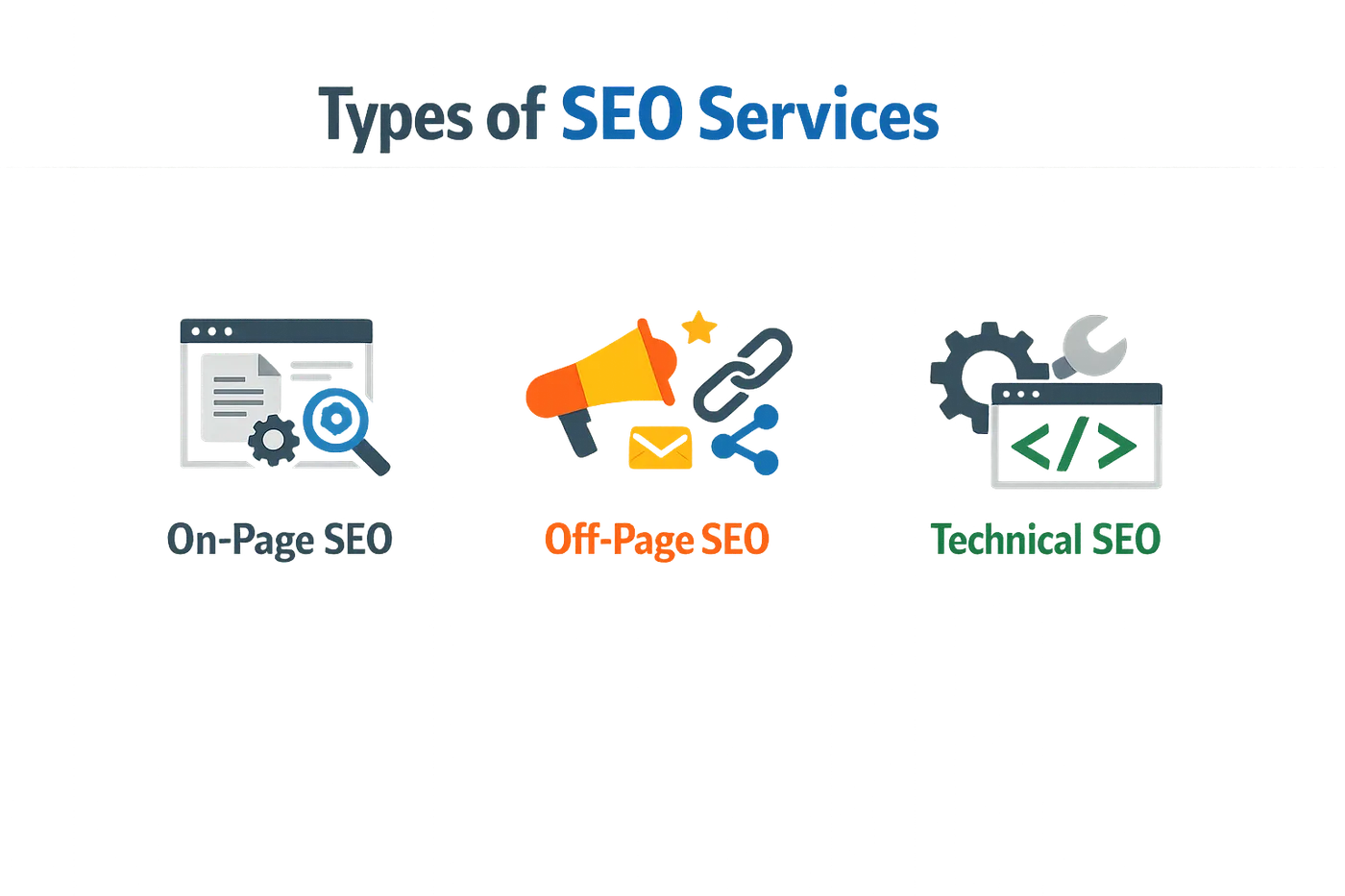
Technical SEO addresses site speed, crawlability, indexing, and structured data. On-page SEO covers title tags, meta descriptions, heading hierarchy, and keyword placement. Off-page SEO focuses on backlink profiles and domain authority. Content services produce blog posts, landing pages, and resource hubs optimized for target queries. Local SEO manages Google Business Profile listings, citations, and geo-targeted pages.
Some providers now offer answer engine optimization (AEO), which targets AI-powered interfaces like ChatGPT and Perplexity rather than traditional SERPs. This includes schema markup tuned for large language models and citation-optimized content structures.
Delivery Models
Monthly retainers bundle ongoing work — audits, content calendars, link outreach, and reporting. Project-based engagements deliver a site migration, a technical cleanup, or a content refresh with a defined start and end. Hourly consulting suits clients who execute in-house but need expert review at decision points. Hybrid models combine a base retainer with project add-ons for seasonal campaigns or product launches.
The right model depends on your team's capacity and the complexity of your site. A ten-page local business rarely needs a retainer; a multi-region eCommerce platform with thousands of SKUs does.
Why Choosing the Right SEO Services Matters
Wrong SEO costs more than the invoice. A vendor who builds links Google flags or stuffs keywords into schema markup can trigger penalties that take quarters to reverse. The direct cost is the retainer. The real cost is the revenue you don't capture while your site sits in algorithmic timeout.
Right SEO compounds. Visibility in traditional search, answer engines, and LLM-powered tools like ChatGPT and Perplexity builds on the same foundation: structured data, clean content, and authority signals that machines can parse. A vendor who understands this delivers results that scale across platforms without rework.
The Business Impact of Effective SEO
SEO drives three outcomes that show up in the P&L. First, qualified traffic: visitors who searched a term your product solves land on a page that converts them. Second, reduced acquisition cost: organic traffic has no per-click cost, so every conversion improves unit economics. Third, compounding authority: as your domain earns links and citations, each new page ranks faster than the last.
Poor SEO reverses all three. Traffic from irrelevant keywords wastes server budget and support time. Thin content or broken schema signals low quality to ranking algorithms, which suppresses the entire domain. Recovery requires auditing every page, disavowing bad links, and rebuilding trust with search engines — work that could have gone into growth.
What Separates Effective SEO from Theater
Effective SEO produces measurable changes in rank, traffic, and conversions within defined timeframes. The vendor shows you the queries you rank for, the pages that earn clicks, and the structured data that answer engines cite. Theater produces reports with charts that don't connect to revenue.
The difference is methodology. Effective vendors start with a technical audit: crawl errors, duplicate content, schema validity, page speed. They fix what's broken before they build new content. Theater vendors skip diagnostics and jump straight to link building or content farms — tactics that add cost without addressing the root problem.
Long-Term Value vs. Short-Term Fixes
SEO is infrastructure. The work you do this quarter creates an asset that generates traffic next year. A vendor who builds that asset — clean schema, authoritative content, a healthy backlink profile — delivers compounding returns. A vendor who chases algorithm tricks delivers a spike that disappears when Google updates its ranking model.
Short-term fixes have their place: if your site has a crawl error that blocks indexing, fixing it is urgent. But if a vendor sells you monthly link packages with no diagnostic work, you're paying for activity, not outcomes. The right vendor audits first, fixes the foundation, then builds on it.
The cheapest SEO vendor is the one whose work you don't have to undo in six months.
How to Choose SEO Services That Deliver Results
Choosing SEO services isn't about picking the cheapest vendor or the one with the flashiest pitch deck. It's about finding a provider whose process you understand, whose results you can verify, and whose timeline you can live with. The wrong choice costs you months and budget; the right one compounds.
Define What You Actually Need
Before you talk to any agency, write down what you're trying to fix. Traffic dropped after a site migration? Local pack rankings disappeared? Content exists but doesn't rank? Different problems need different services. An agency that specializes in technical audits won't be your best fit if you need a content operation that ships 50 posts a month.
Identify whether you need on-page optimization, keyword research, link building, or a comprehensive strategy. If you're not sure, that's fine — but know your goals (revenue, leads, traffic to specific pages) and your constraints (budget, timeline, internal resources). Agencies can't scope work without knowing what success looks like for you.
Check Their Track Record
Ask for case studies that match your situation. If you run an e-commerce site, a case study about ranking a law firm's blog doesn't tell you much. Look for proof: before-and-after traffic screenshots, rankings for specific keywords, revenue impact if they'll share it. Be skeptical of agencies that only show aggregate traffic charts with no context.
Look for an SEO company with 5+ years of experience and clients in your vertical or adjacent ones. Longevity matters because Google's algorithm changes constantly; agencies that survived multiple core updates know how to adapt. Ask for references and actually call them. Ask what broke, how the agency handled it, and whether they'd hire them again.
Understand Their Process
An agency should be able to walk you through their process in plain language. What happens in month one? Month three? When do you see a draft content calendar, a backlink report, a technical audit? If they can't explain it or if the explanation is all jargon, that's a signal.
Ask what tools they use and why. Ask how they prioritize work when you have 200 broken pages and 12 keyword opportunities. Ask how they handle a penalty or a traffic drop. The answers show you whether they have a system or whether they're improvising.
Step 1
Request a sample audit
Before you sign anything, ask the agency to audit 5–10 pages from your site. A real audit identifies specific issues (duplicate title tags, slow load times, thin content) and explains why each one matters. If they send back a generic PDF with no page-level detail, move on.
Evaluate Reporting and Communication
Find out what reports you'll get and how often. Monthly is standard; weekly is overkill unless you're in a crisis. Reports should show rankings, traffic, conversions (if they have access), and work completed. If a report is 40 slides of graphs with no narrative, you'll spend more time decoding it than acting on it.
Ask how they communicate when something goes wrong. Do they email? Slack? Schedule a call? Do they wait for you to notice a drop, or do they flag it proactively? You want an agency that tells you bad news fast, not one that hides it in slide 38.
Clarify Pricing and Deliverables
SEO pricing varies wildly. Retainers range from $2,000/month for basic local SEO to $25,000/month for enterprise campaigns. Understand what's included: how many pages optimized, how many links built, how many hours of strategy. If the contract says "ongoing optimization" with no specifics, push for a deliverables list.
Watch for agencies that lock you into 12-month contracts with no performance clauses. A 3–6 month initial term is reasonable; anything longer should come with clear milestones and an exit option if they don't hit them. Avoid agencies that require you to use their proprietary CMS or hosting — you should own your content and your site.
Ask the Right Questions
Before signing a contract, ask targeted questions about their experience, strategies, past results, communication practices, and unique value. Here are a few that surface how they actually work:
- What's the biggest SEO mistake you've seen a client make, and how did you fix it?
- How do you handle a Google core update that drops our traffic by 30%?
- What's your process for vetting link opportunities?
- How do you decide what content to create first?
- What happens if we don't see results in six months?
The answers matter less than whether they have answers. An agency that's done this before won't need to think hard about these.
Look for Strategic Alignment
The best SEO agency for you is the one that understands your business model. If you're B2B with a 9-month sales cycle, you need an agency that knows how to optimize for bottom-of-funnel keywords and track assisted conversions. If you're local retail, you need someone who lives in Google Business Profile and local pack rankings.
Ask how they'll integrate with your team. Will they work directly with your developers, or do they expect you to be the intermediary? Do they need access to your CMS, analytics, and Search Console, or will they work off screenshots? Misaligned expectations here create friction that kills momentum.
For a deeper look at how AI search is changing what visibility means, see GEO vs SEO: Key Changes and What Still Matters.
Best Practices for Evaluating SEO Services
Evaluating SEO services requires a methodical approach. The agencies that survive your vetting process are the ones whose claims you can verify.
Start With Case Studies and Client References
Case studies show you how an agency handles real work. Look for specifics: traffic change percentages, ranking improvements for named keywords, time frames. Ask for client references and call them. When you do, ask results-oriented questions: "How long did it take to see meaningful results?" and "What specific metrics improved?" Vague answers mean the agency didn't move the needle.
Verify Years in Business and Reputation
Look for agencies with at least five years of operating history. SEO changes constantly; agencies that have survived multiple algorithm updates know how to adapt. Check online reviews, but also search for the agency name plus terms like "complaint" or "lawsuit." If they've burned clients, someone documented it.
Ask About Their Approach to Schema Markup for AI
A competent agency should explain how they use structured data to make your content visible to both traditional search engines and LLMs. If they can't articulate their schema strategy, they're behind the curve.
Demand Transparent Reporting
Ask what metrics they report, how often, and in what format. Monthly reports should include organic traffic, keyword rankings, backlink acquisition, and technical health metrics. If an agency resists showing you raw data or only provides summary PDFs, they're hiding something.
The best agencies show you the same dashboards they use internally—no sanitized client versions.
Evaluate Their Communication Style Early
Your first few interactions predict the relationship. Do they respond within 24 hours? Do they ask detailed questions about your business before proposing solutions? Agencies that pitch generic packages before understanding your goals will deliver generic results.
Watch for Red Flags in Promises
Any agency that guarantees specific rankings or promises immediate results is lying. Search rankings depend on competition, algorithm changes, and factors outside any agency's control. Legitimate providers talk about process, timelines, and realistic expectations—not guarantees.
Common Mistakes to Avoid When Choosing SEO Services
Most businesses trip over the same handful of errors when vetting SEO providers. The expensive mistakes happen early — before you sign — when you skip the structural questions or accept promises that sound good but break on contact with how search engines actually work.
Accepting Ranking Guarantees
No one can guarantee a specific position in Google. Google itself says so in its guidance on hiring SEO help. When an agency promises "first page in 90 days" or "top three for your keyword," they are either lying or planning to game short-term loopholes that collapse the moment Google updates its algorithm. Legitimate providers talk about traffic trends, conversion lift, and visibility across answer engines — not fixed rankings.
Choosing on Price Alone
The cheapest bid often hides the highest total cost. A $500/month retainer that delivers no measurable traffic is more expensive than a $3,000/month engagement that doubles qualified leads. Price the engagement by outcome, not by the monthly invoice. Ask what you get for the spend: how many pages optimized, how many schema implementations, what reporting cadence, which tools included in the fee.
Cheap SEO typically means offshore link farms, thin content written by non-specialists, and no structured data work. You pay to clean up the mess later.
Skipping the Measurement Discussion
If the provider does not ask what you currently measure or what your internal reporting looks like, they are guessing. SEO without measurement is theater. Before you sign, agree on:
- Which metrics you will track (organic sessions, conversions, answer-engine citations, ranking distribution)
- Where the data lives (Google Analytics, Search Console, the provider's dashboard)
- How often you review it (monthly is standard; quarterly is too slow)
- What constitutes success at 90 days, six months, and twelve months
No measurement plan means no accountability.
Ignoring Content Ownership
Some agencies write content, publish it to your site, and retain the copyright. When you leave, they pull the content or charge you to keep it. Others write content and transfer full ownership on delivery. Clarify this in the contract. If the agency balks at transferring ownership of work you paid for, that is a structural problem.
The same applies to schema markup, technical fixes, and link profiles. Make sure you own everything the provider builds.
Overlooking Structured Data and AI Visibility
Traditional SEO stops at meta tags and backlinks. Modern search — especially answer engines like ChatGPT, Perplexity, and Google's AI Overviews — relies on structured data to parse and cite your content. If the provider does not mention schema markup, JSON-LD, or answer engine optimization, they are solving last decade's problem.
Ask explicitly: do you implement schema? Which vocabularies? How do you measure whether LLMs cite our content?
If the provider does not ask what you currently measure, they are guessing.
Failing to Check References
Most buyers skip this step. Do not. Ask for three client references in your industry or adjacent verticals, then call them. Ask:
- What improved in the first six months?
- What broke or took longer than expected?
- How did the agency handle a setback or algorithm change?
- Would you renew the contract?
If the provider cannot produce references, or if the references are vague or unenthusiastic, that tells you something.
Signing Long Contracts Without Escape Clauses
SEO takes time, but a 12-month no-exit contract is a trap if the relationship sours or the provider underdelivers. Look for agreements with a 90-day mutual out after an initial commitment period (typically three to six months). That gives both sides enough runway to see whether the engagement works, without locking you into a year of poor results.
Frequently asked questions
How much should SEO services cost?
Pricing varies by scope and market. A local campaign might run $1,500–$3,000 per month. Enterprise work with multiple properties and technical audits starts around $10,000 per month. Hourly consulting sits between $150 and $300. One-time audits range from $2,500 to $15,000 depending on site size and complexity.
If a proposal quotes $500 per month for comprehensive SEO, the vendor is either automating everything or cutting corners. Either way, the work will not move the needle.
What deliverables should I expect each month?
A professional engagement includes a written report showing ranking changes, traffic trends, and completed tasks. You should see keyword movement data, new content published or optimized, backlink acquisition records, and technical fixes logged with before-and-after screenshots. If the vendor cannot show you what changed and what it cost in hours, you are paying for a black box.
Monthly calls are standard. Quarterly strategy reviews are common for retainers over $5,000 per month.
How long does it take to see results from SEO services?
Most campaigns show measurable movement in three to six months. Technical fixes and on-page optimization can produce ranking shifts in weeks. Link-building and content authority take longer—often six to twelve months before you see sustained traffic growth.
Anyone promising page-one rankings in 30 days is either targeting zero-volume keywords or running tactics that will trigger a penalty when the algorithm catches up.
Should I hire an agency, a consultant, or build an in-house team?
It depends on budget, velocity, and control. An agency gives you a full team and established process. A consultant provides strategic direction without the overhead. In-house makes sense when SEO drives enough revenue to justify three or more full-time roles and you need daily iteration.
For businesses under $10 million in annual revenue, a consultant or small agency usually delivers better ROI than hiring internally. For companies with complex technical estates or dozens of properties, in-house plus agency support is common. For guidance on selecting tools that fit different team structures, see AI Visibility Platforms vs Point Tools: Which Fits Your Team?
What questions should I ask during the sales process?
- What ranking and traffic data will I see each month, and in what format?
- Who specifically will do the work, and what is their background?
- What happens if rankings drop or traffic stalls?
- How do you handle algorithm updates?
- What is your average client retention, and can I speak to a current client?
- What tools do you use, and will I have login access?
- How do you measure success, and what does failure look like?
If the vendor cannot answer these directly, the relationship will produce more confusion than results.
Can I do SEO myself, or do I need to hire someone?
You can handle basic on-page optimization, content publishing, and site speed fixes without outside help. Tools exist for keyword research, technical audits, and rank tracking. If you have time to learn and your market is not intensely competitive, a founder or marketing generalist can move the needle.
You will likely need help when you hit technical debt—such as crawl errors, schema implementation, or large-scale migrations—or when link-building requires outreach at scale. Most businesses hire when the opportunity cost of doing it internally exceeds the cost of paying someone who already knows how.
What are the biggest red flags when evaluating SEO services?
- Guaranteed rankings or traffic promises
- No clear reporting cadence or access to live data
- Refusal to explain their process in plain language
- Contracts that auto-renew without a clear exit clause
- Overemphasis on vanity metrics like domain authority instead of revenue or conversions
- Use of private blog networks or purchased links
- No named point of contact or rotating account reps every quarter
Any one of these should end the conversation.
How do I know if my current SEO provider is doing a good job?
Check three things: rankings for your target keywords, organic traffic trends, and whether the work matches the invoice. If you are paying for content and no new pages have published, or paying for links and the backlink profile has not grown, the vendor is not delivering.
Good providers show you the work, explain what changed, and connect it to business outcomes. If you cannot see the work or the vendor deflects when you ask, start the search for a replacement.
Conclusion
Choosing SEO services is a procurement decision. You are buying a specific scope of work, delivered on a timeline, with measurable outcomes. The vendor who can show you what they did, when it moved the needle, and how much it cost is the one you can trust to do it again.
The strongest signal is a vendor who asks hard questions before they quote. If they want to see your current traffic distribution, your conversion paths, and your internal resource capacity, they are scoping real work. If they promise page-one rankings without asking what you sell or who searches for it, they are selling a script.
I spent fifteen years buying enterprise software and another ten building it. The pattern holds: vendors who lead with process documentation and measurable checkpoints deliver. Vendors who lead with adjectives and case studies from unrelated industries do not. When you evaluate SEO services, you are evaluating the same operational fundamentals you would apply to any other professional engagement—clear scope, defined milestones, transparent reporting, and a contract that specifies what happens when the work does not perform.
The right SEO partner becomes an extension of your growth infrastructure. The wrong one becomes a line item you explain in next quarter's variance report. Choose the vendor whose work you can defend in a budget review, and you will have chosen the vendor who delivers results.
For teams expanding into AI-driven search channels, understanding how to rank in AI search results complements traditional SEO selection criteria and prepares your vendor evaluation framework for the next visibility layer.
Related reading
How to Choose an Online Marketing Platform for Small Businesses